01Who may do what
Rigging means anything that holds kit above people: flown speakers, truss, hoists, lights on a bar. Staging means anything people stand on. Both can kill. So the first lesson is not how to do it. It is who is allowed to.
| Job | Who does it |
|---|---|
| Speaker on a tripod stand, T-bar with lights, ground stack | Trained crew, checked by the crew chief |
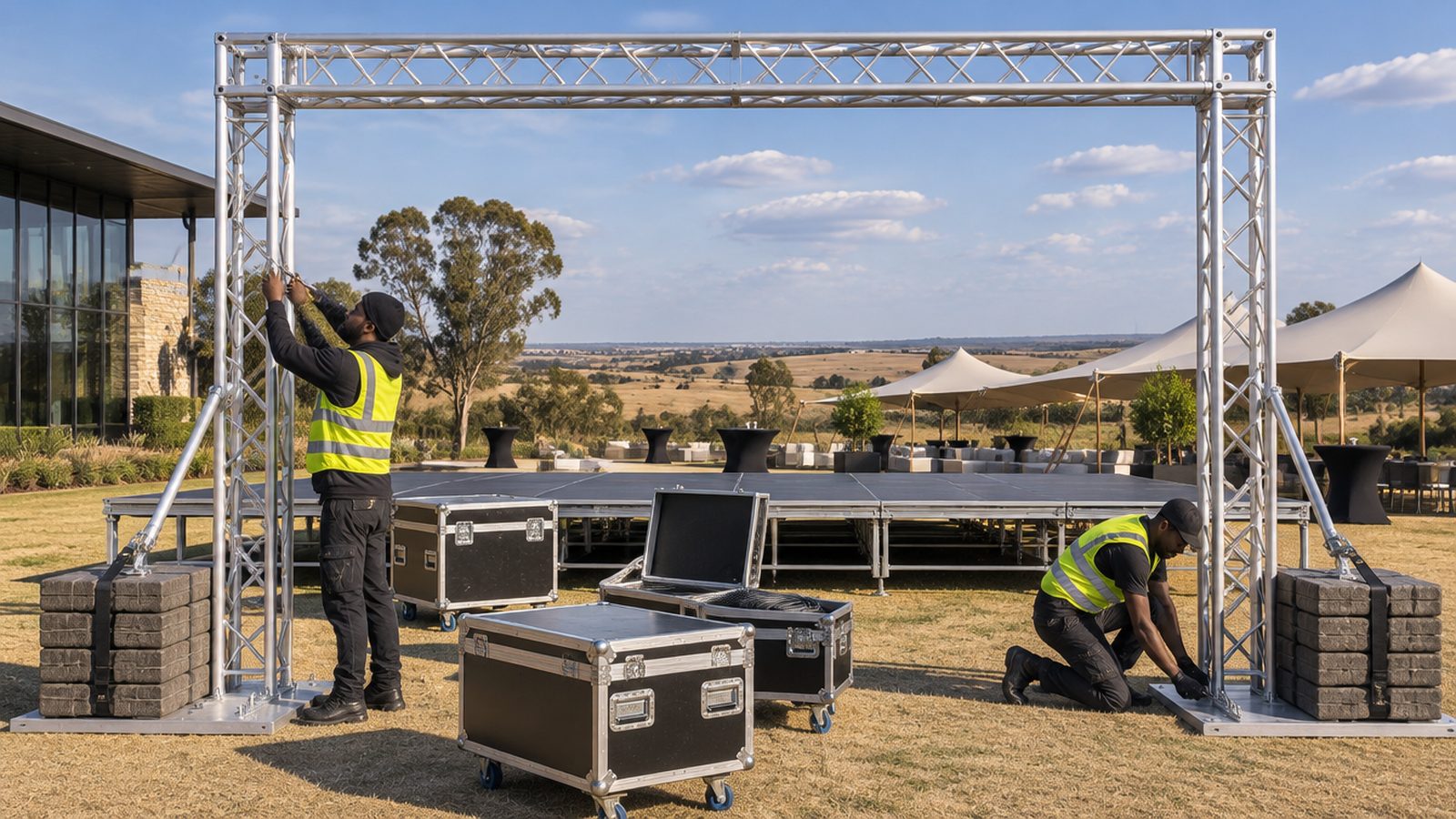
| Truss totem or goalpost on base plates, built to the maker's manual | Trained crew under a competent rigger or the crew chief who signs it off |
| Anything flown: hoists, motors, hanging from a roof or beam | A competent rigger only |
| Stages, roofs, big screens, scaffold towers | The stage or structure supplier, with their sign-off |
At B&W we ground-stack speakers and put lights on stands. We have one ladder rack. Nothing goes overhead unless a competent rigger has rigged it.
Competent
Trained, experienced and appointed for that job. Being strong, or having seen it done, is not competent.
Signed off
Stages and structures are checked and signed by the person responsible before anyone uses them.
Your right
You may refuse a lift or a climb you are not trained for. Tell the crew chief. That is the job done properly.
If it is above heads and you did not get trained on it, you do not build it. You fetch the person who did.
02Stands: the rigging you do every day
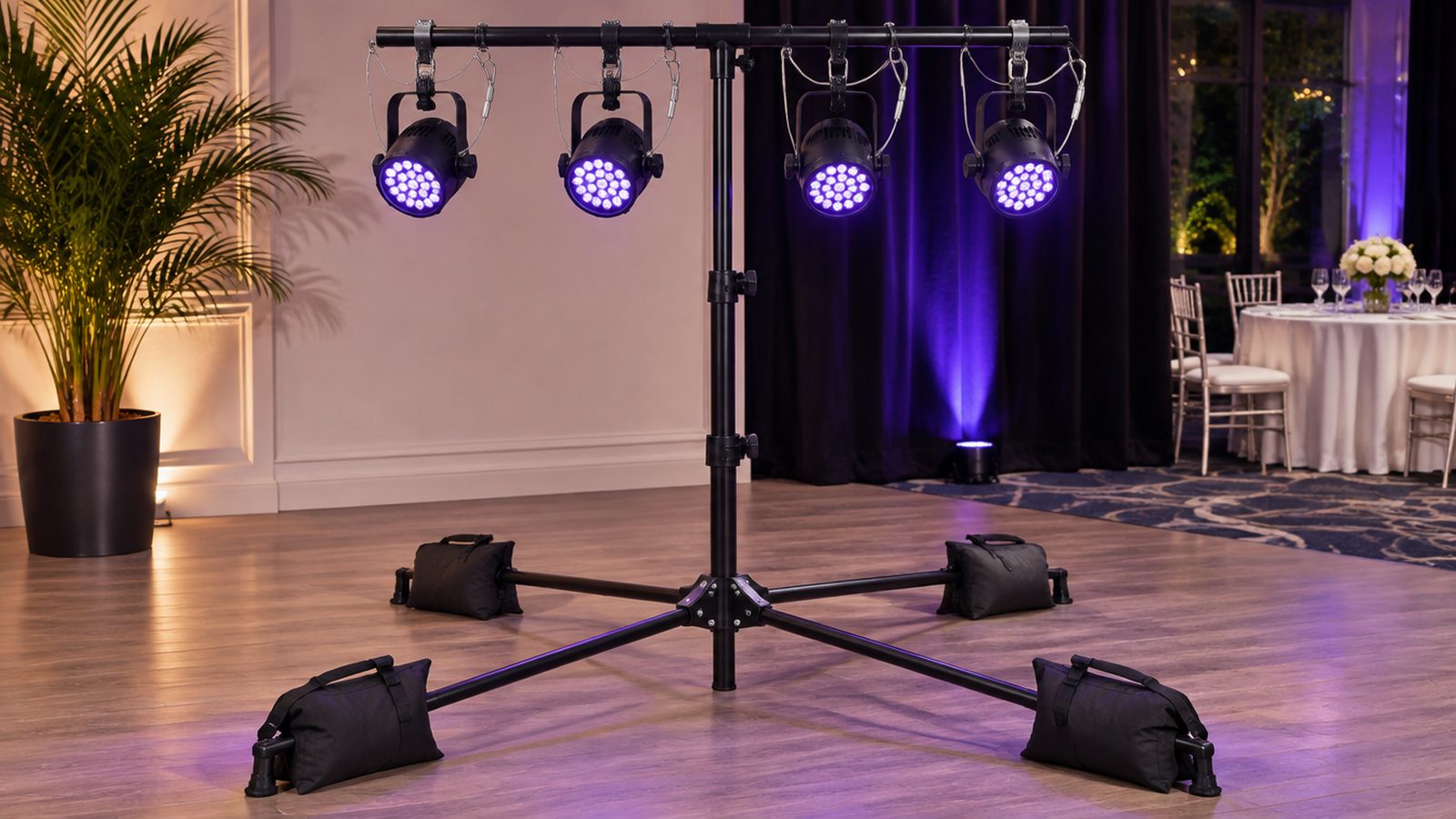
Most accidents on small shows are not truss. They are a speaker stand or a T-bar that went over. A stand is safe only inside its limits.
- Check the load. Every stand has a maximum load printed on it or in its manual. The speaker or the lights must weigh less.
- Legs fully out and locked. A narrow base tips. Put one leg pointing at the audience side.
- Level, firm floor. Not on a slope, a carpet edge, or soft grass without a board under each foot.
- Pins in. The safety pin goes through the mast at every height. Never rely on the clamp alone.
- Two people to lift a speaker onto a stand. One lifts, one guides the socket onto the pole.
- Weight on the legs. Sandbags on the legs outdoors and anywhere people walk past.
- Cables down the mast and taped to the floor, so a trip on the cable does not pull the stand.
Wind-up stands come down under control, with a hand on the winch and nobody underneath. Never release the brake and let it drop.
Low and wide beats high and narrow. If the stand has to go that high, it needs ballast or a different plan.
03Truss: how it carries load
Truss is a light aluminium frame. It is strong along its length when it is loaded the way the maker designed. It is weak when it is dented, twisted, or loaded in the wrong place.
Load table
Each truss type has a table: how much weight for how long a span. The number is in the manual, not in anyone's head.
Point and spread
One heavy item in the middle is a point load. The same weight spread along the span is easier on the truss. The table gives both.
Connections
Every joint uses the right pins or bolts, all of them, with the clips in. A missing pin is a missing joint.
Damage
A dent, a crack at a weld or a bent tube takes that length out of service. Tag it red.
Try it: add up the load
Add what you plan to hang. Type the limit from the maker's load table for your span. The tool does the adding. It does not know your truss.
No load table, no load. If nobody on site can show you the number for that truss and that span, nothing gets hung on it.
04Ground support and ballast
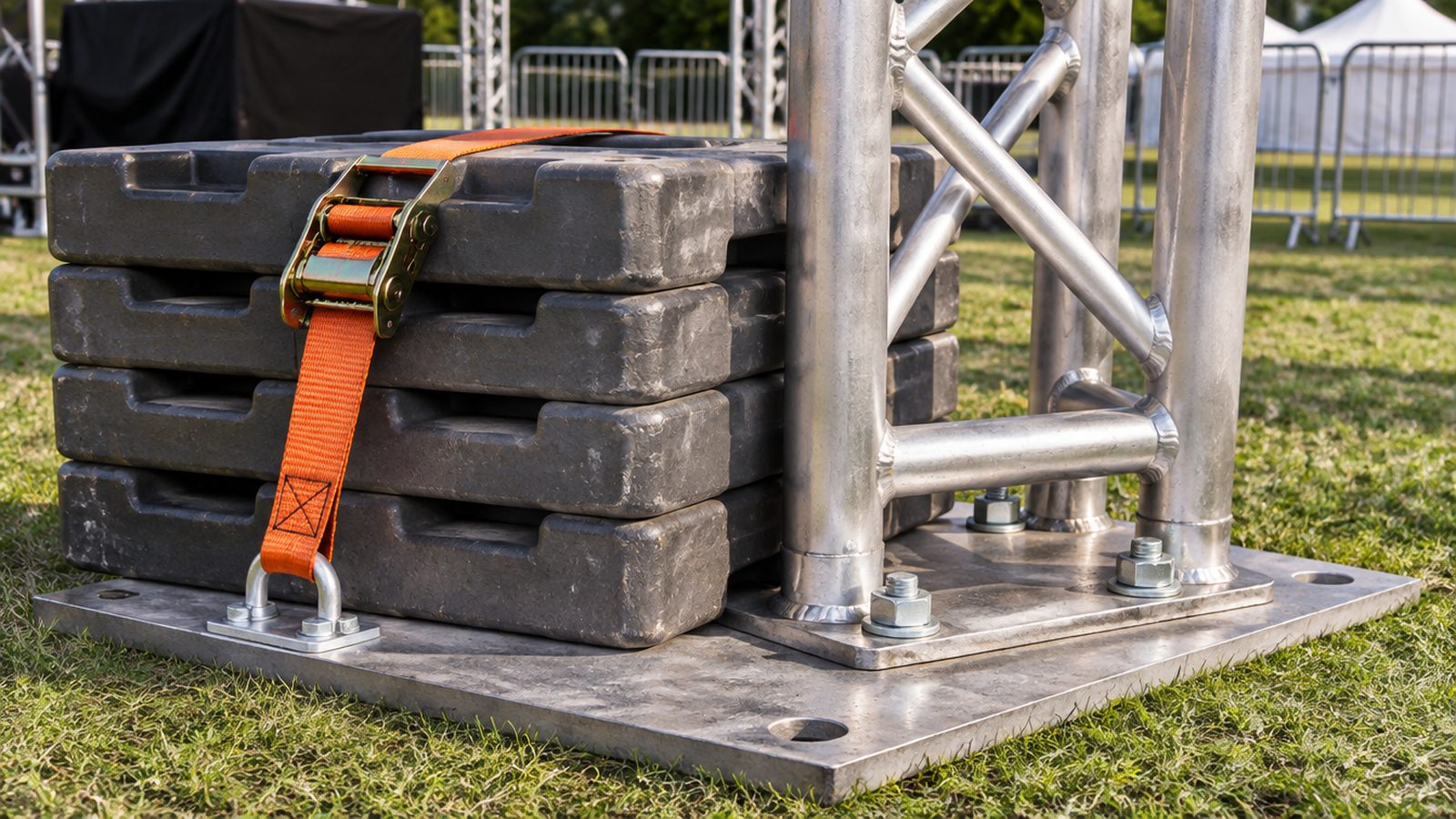
A truss totem or goalpost stands on base plates. A light breeze or a person leaning on it puts a sideways force at the top. The base and the ballast are what resist it.
- Base plates flat on firm, level ground. On grass or sand, a board or sole plate under each one.
- Ballast as the plan says. The amount comes from the supplier or the engineer for that structure. Water tanks are filled to the mark. Concrete or steel weights are counted.
- Ballast fixed. Strapped or bolted so it cannot be kicked off or slide.
- Banners and screens are sails. A branded scrim on a truss catches wind many times harder than bare truss. It changes the ballast needed.
- No guy ropes across walkways without a barrier and a marker.
Ballast is part of the structure. Nobody borrows a weight for a gazebo.
05Clamps, bonds and the zone below
Everything hung has two attachments: the thing that holds it, and the thing that catches it when the first one fails.
- Clamp rated for the load, done up by hand until tight, then checked.
- Safety bond (steel wire with a clip) through the fixture's bond point and round the truss or bar. Short, so the drop is short.
- No loose items. Barn doors, gel frames, lens hoods and tools are bonded or removed.
- Zone below. Tape it off. Nobody walks under while anything is being lifted, adjusted or taken down.
- Hard hats for everyone working under or near overhead work.
- Call it. Shout "heads" before anything moves overhead and wait for the zone to clear.
Cable ties, tape and rope are not rigging. They do not hold a light, a speaker or a screen.
Two attachments on everything overhead. If you can only find one, it is not finished.
06Stage decks, steps and edges
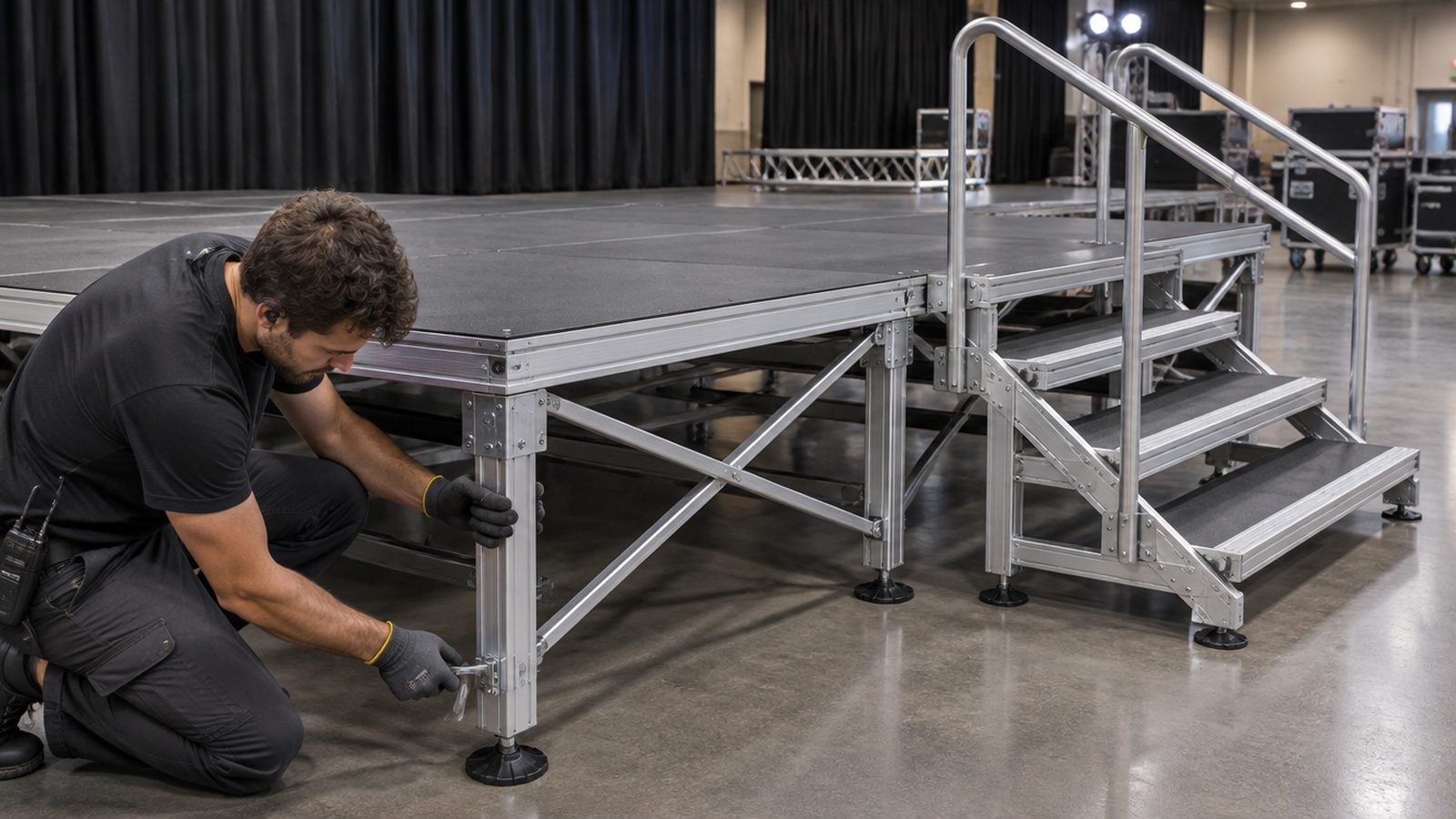
- Legs locked in every socket, all the same height. Check each one by hand.
- Decks clamped to each other so they cannot drift apart and open a gap.
- Bracing as the maker's manual says for that height.
- Load. Each deck has a rated load per square metre. A grand piano, a big LED screen or a crowd of dancers needs checking against it.
- Edges. White or lumo tape on every edge and step nose. A handrail on the back and sides once the stage is high enough to hurt in a fall. Follow the venue and the safety officer.
- Steps fixed to the stage, with a rail, lit during the show.
- Nothing stored underneath that people must crawl to fetch during the show.
Jump on it before the client does. Walk every deck and every step before you load kit on.
07Wind and weather outdoors
Outdoors, the wind decides. Every tent, stage roof, screen and truss structure has wind limits set by its maker or its engineer. Those limits are written in a wind plan: at this speed we do this.
Try it: read the wind plan
Type the two limits from your structure's wind plan and the current gust reading. These example numbers are placeholders, not a rule.
- Gusts matter more than the average. Read the gust.
- A Highveld storm arrives fast. Act on the first limit, not when the scrim is already flapping.
- Lightning: stop work at height and on stage, get people inside (Module 13).
- Wet decks are slippery. Dry the steps and the stage edge before the show restarts.
Lowering early costs ten minutes. Lowering late is not possible.
08Inspect, sign off, strike
A structure is checked three times: when it is built, before doors, and after any weather or knock. Then it comes down in the reverse order it went up.
- Right person built it
Crew for stands. Rigger or supplier for anything flown or structural. - Level and firm
Bases flat, sole plates on soft ground, legs locked. - All pins and clips in
Every joint, every stand mast, every deck leg. - Load known
Weight added up and under the maker's limit. - Ballast in place and fixed
As the plan says, strapped down. - Bond on every fixture
Clamp plus safety bond. Nothing loose. - Edges and steps marked
Tape, rails and light on steps. - Wind plan and watcher named
Outdoors: who reads it and what the numbers are. - Signed off
Crew chief, rigger or supplier has checked and said yes.
Strike
- Clear the area below first. Audience out, zone taped.
- Kit off before structure down. Lights and speakers come off while the truss is at working height.
- Lower under control. Never drop, never pull pins on a loaded joint.
- Check every length for damage as it goes back in the dolly. Tag anything bent.
If something looks wrong, say so and stop. Nobody was ever fired for a five-minute check.
09Check what you learnt
Ten questions. Pick an answer for each, then press Mark my answers. You need 8 out of 10 to pass this module. You can retry as often as you like.
Ten questions. Circle one answer for each. The answer key is on the last page. Pass mark: 8 out of 10.
Answer key
Photos: scene photographs are AI-generated illustrations and do not show B&W Productions equipment or events. This module is crew training, not a substitute for the manufacturer's manual, the venue's rules or the event safety officer's instructions.