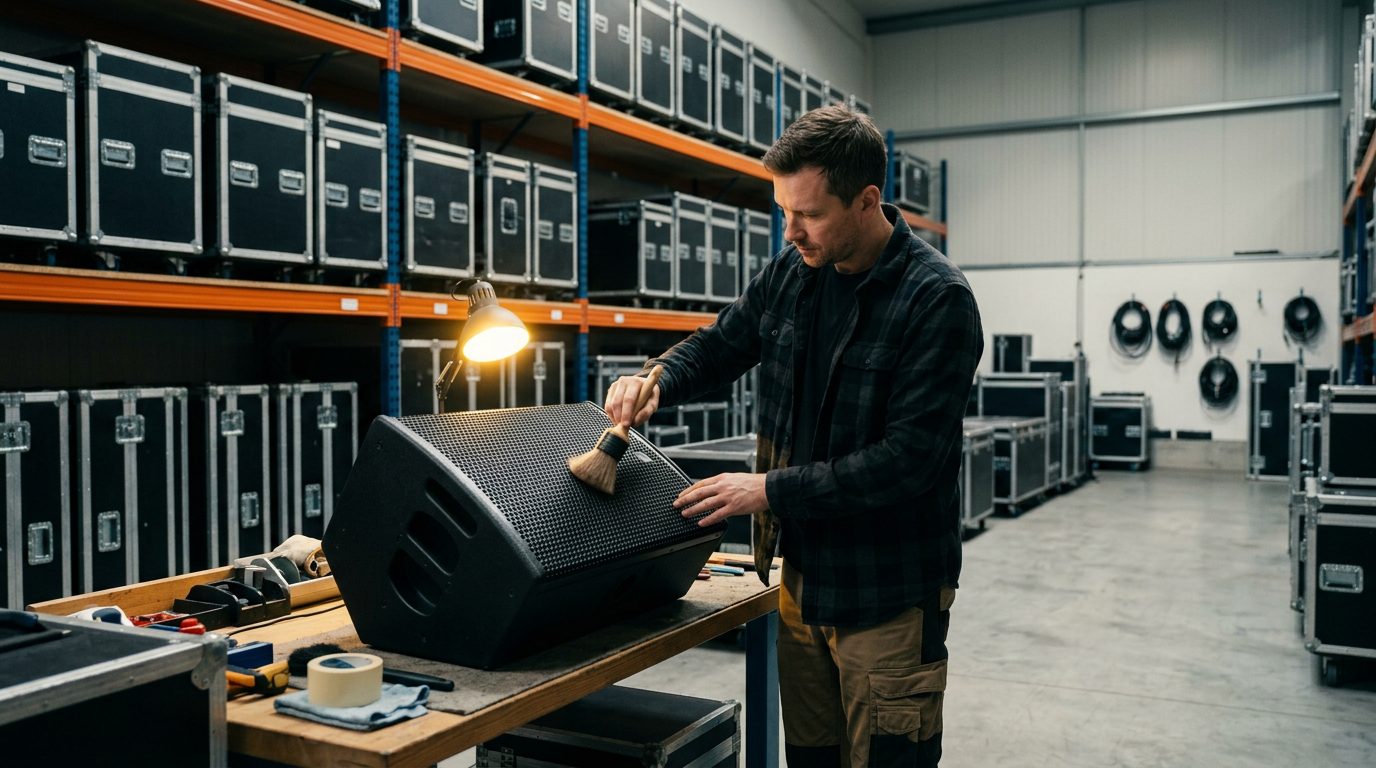
01Why kit care pays
Every speaker, cable and mixer on the truck was bought with company money. It only earns that money back if it works, show after show. Looking after it is not a chore for the warehouse staff. It is part of your job on every event, from the first case you open to the last one you latch.
Replacement cost
A dropped speaker or a drowned mixer is a new purchase, not a repair. That money would otherwise buy new kit or pay for the next job.
Show-day failure
A dead box at 8 pm has no fix. You work around it with less sound, and everyone in the room can hear the gap.
The client's view
The client does not see the warehouse. They see dirty cases, taped cables and a crew that fixes things during doors. That is what they remember when they book again.
If you touched it, you own it. Put it back clean, counted and working, or tag it as faulty. Never put it back and say nothing.
02Check-out and check-in
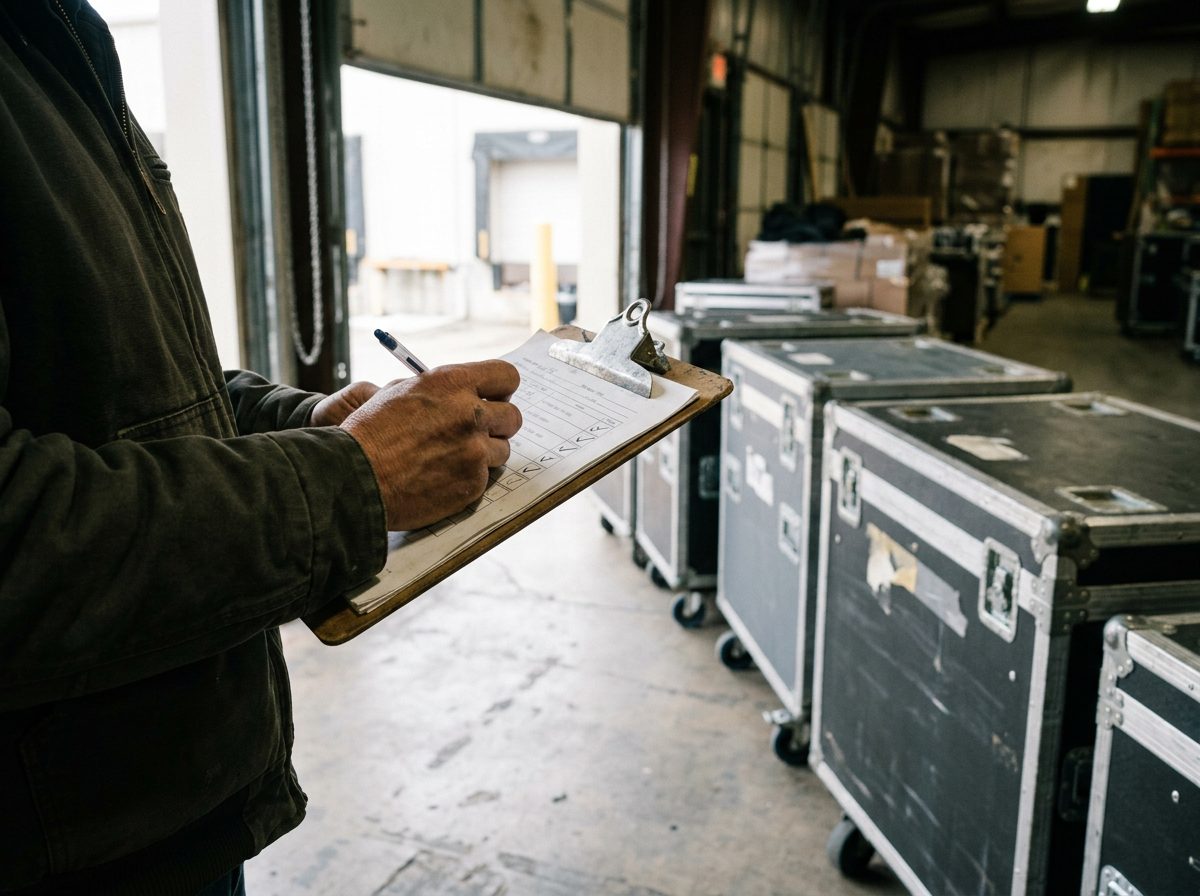
You cannot look after kit you cannot count. The whole system is one list used twice: count out against it, count back against it. The difference is what went missing or broke on the job.
- Pick from the written list, not from memory. Tick each line as the item goes in the case or on the trolley.
- Count out with a second person where you can. Count the small things: XLRs, power leads, clamps, stands, adaptors, batteries. They are the first to walk away.
- Count back at the venue before you leave, not at the warehouse. A missing lead is easy to find while the room is still set up.
- Fill in the stock sheet with the back count and sign it.
- Report the gap that night. Message the crew chief with the item, the quantity, the last place you saw it. By next morning nobody remembers.
Try it: check this rig back in
The rig below went out on the pick list. Type how many of each came back. The status shows what is missing.
| Item | Out | Back | Status |
|---|---|---|---|
| Speaker tops | 2 | — | |
| Subs | 2 | — | |
| Mixer | 1 | — | |
| XLR cables | 6 | — | |
| Power leads | 2 | — | |
| Microphone | 1 | — | |
| Mic stand | 1 | — |
| Item | Out | Back | Missing |
|---|---|---|---|
| Speaker tops | 2 | ||
| Subs | 2 | ||
| Mixer | 1 | ||
| XLR cables | 6 | ||
| Power leads | 2 | ||
| Microphone | 1 | ||
| Mic stand | 1 |
Count back before you leave the venue. A missing item reported the same night can still be found. A week later it is gone.
03Transport
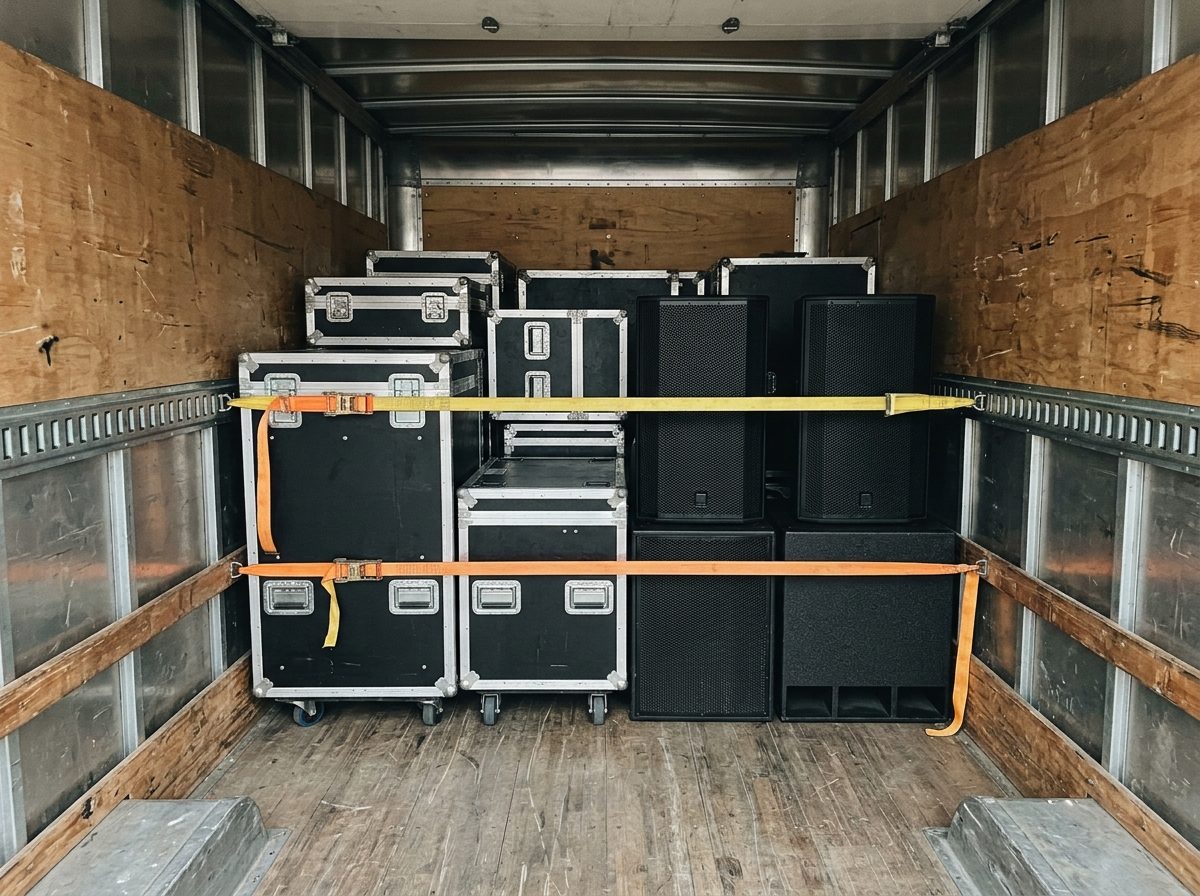
The road does more damage than the show. A truck moves, brakes, corners and hits potholes for hours. Kit that is loose or badly stacked takes every one of those knocks.
- Close and latch every case. An open lid sheds dust and rattles, and a half-latched case can open in a corner.
- Heavy at the bottom and against the bulkhead. The bulkhead is the wall behind the cab. In a hard stop the load pushes forward, and that wall stops it, not the cab.
- Strap it. Ratchet straps across the load, over the top, pulled tight, with no gaps for it to slide into.
- Nothing loose. Stands, clamps and lead bags go in a case or a bag, never rolling on the floor.
- Speakers face-down, or as the case allows. Follow how the box was designed to sit. Drivers and grilles stay off hard surfaces and off the strap.
- Nothing stacked on a DJ case lid. The lid flexes and the gear inside takes the load.
B&W runs 3 sound trucks. Each truck has its own load plan. Learn the plan for the truck you are on and load to it every time, so the next crew can find everything blind.
At B&W each Pioneer XDJ-RR travels in its own flat flight case. The case is the dust cover and the shock protection. Lid on and latched the moment the set is over.
Never lift a heavy sub alone. Two people, bend the knees, and use a trolley or the tail lift if there is one. Never ride in the back of the truck.
04Speakers and amps
A speaker is a paper or plastic cone on a coil of fine wire, in a box. It is tougher than it looks and easier to ruin than it looks. Amps are the opposite: heavy, but they die from heat.
Speakers
- No dropping, no sliding. A speaker that lands on a corner can crack the cabinet and shift the driver. Carry with two people, set down, never drop the last 10 cm.
- Clean the grilles with a soft brush and a dry cloth. No water on a grille and none on the cone behind it.
- Check the drivers at low level. Play a sweep or steady music at low volume, put your ear near the box and listen for buzzes, rattles or one speaker sounding thinner than the others. A buzz is a damaged cone, a loose screw or a cracked cabinet. Tag it. Do not turn it up to see if it clears.
Amps
- Never block the vents. Not with a jacket, a cable bag or the next rack. Leave space behind the rack for the hot air.
- Clean the dust filters and fans on the schedule in Lesson 8. A filter packed with dust and haze residue is as bad as a blocked vent.
- Let the amp cool down before casing it. Power down, leave the fans running a few minutes if the amp allows, and case it only when the chassis is cool to the hand.
Brush the grilles. Listen at low level. Keep the amp's vents clear. Case it cool.
05Mixers, DJ kit and turntables
Mixers and DJ gear are full of small moving parts: faders, pots, switches, jacks and a stylus the size of a grain of sand. They fail from dust, drink and rough handling, and they fail in the middle of a set.
Dust covers on
Cover every mixer and deck the moment the set ends. Dust inside a fader is what makes it crackle a year from now.
No drinks on the desk
Liquid goes through the fader slots straight onto the circuit board. Put drinks on a separate table, a metre from the desk. Tell guests and performers politely.
Contact cleaner, by the tech
Crackly faders and pots are cleaned only with the right contact cleaner, and only by the tech. Not WD-40. It leaves a film that attracts dust and makes the problem worse.
Stylus care
Lift the needle off the record before you touch the deck. Brush the stylus front to back with its brush, never sideways. Put the guard on when it is cased. A bent stylus cannot be fixed.
USB ports
Plug straight in, no bending or levering. Cap or tape unused ports in dusty venues. A damaged port can cost a whole mixer board.
Firmware in the warehouse
Update firmware in the warehouse, test it, and only then load the kit. Never update on site, where a failed update leaves you with a dead unit and no time.
Do not spray WD-40 or any household cleaner into a mixer, fader or deck. If it crackles, tag it. The tech cleans it with the right product.
06Lights and effects
Lights, haze and CO2 are what the client remembers visually, and they are the kit that gets dirtiest. Haze fluid leaves a film on every lens and every fan it touches. Gas cylinders add a safety job to the cleaning job.
Lights
- Clean the lenses with a soft, lint-free cloth and glass cleaner on the cloth, not sprayed on the fixture. Haze residue makes the beam dim and soft.
- Clean the fans and vents. A dirty fan overheats the fixture and shortens its life. Use compressed air or a soft brush, with the fixture off and cooled.
- Check the clamps and safety bonds before each job. A fixture falling is a safety problem, not a care problem.
Smoke and haze machines
- Flush the machine with the maker's cleaning fluid, as the manual says. Run it until the output is clean, so the heater and pump do not clog with old fluid.
- Use only the fluid the maker specifies. The wrong fluid blocks the heater, and can leave a residue on kit and floors.
- Empty the tank before long storage, and store the machine upright.
B&W carries 4 smoke machines and 4 CO2 jets. Each smoke machine goes back in its case with the maker's fluid noted on the lid. CO2 cylinders are counted out and back like any other kit.
Never carry a cylinder by the valve. Never leave one loose in a vehicle. Never use a hose with a cut or a bulge. Tag it and tell the crew chief.
07Batteries and wireless
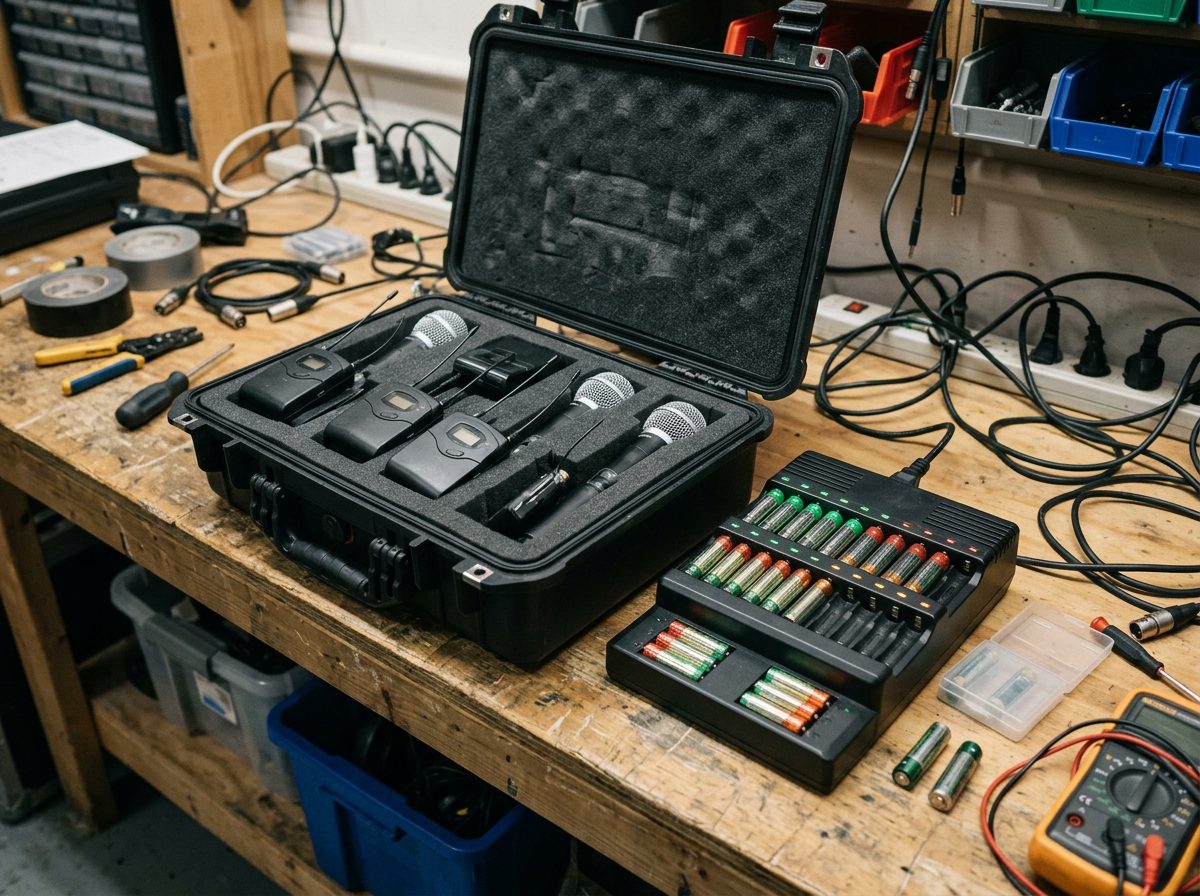
Most wireless failures are not radio failures. They are flat batteries, a loose battery door or a corroded contact. The fix is a routine, not a clever technique.
- Rechargeable packs are charged and rotated. Charge after every job. The oldest charged pack goes out first, so they all get used and none sit flat.
- Alkalines come out after every show. Used or not. They go in the used-battery box, never back on the shelf as new. Fit fresh ones for the next job.
- Never leave batteries in a transmitter. They can leak and ruin the contacts, and a leaking alkaline can ruin a mic.
- Check the battery doors close and latch, and the contacts are clean and bright.
- Check the antennas are straight, screwed on and not cracked. A bent antenna costs range and causes dropouts.
- Store transmitters in their case, with the lid shut. Handhelds in a bag together knock heads and bend grilles.
B&W's Shure wireless (2 handhelds and 4 Countryman headsets) is arriving. When it lands, its charging, battery and case routine goes on the same schedule as everything on this page.
After the show, batteries come out. Alkalines go in the bin, rechargeables go on the charger, and the transmitter goes in its case.
08Faults, repairs and the maintenance schedule
Everything above fails sometimes. What matters is that a fault is found, recorded and fixed, and that faulty kit does not go back on the shelf looking healthy.
The repair log
One line per fault, written in the log at the warehouse or sent to the crew chief. Four things, always.
| Date | Item | Fault | Who found it |
|---|---|---|---|
| 24 Oct | Sub 2, left of rack | Rattle at low level, grille loose | Thabo |
| 24 Oct | XLR 10 m, number 3 | Crackle when bent at the plug | Anele |
The maintenance schedule
| When | What | Who |
|---|---|---|
| After every show | Count back. Wipe down. Batteries out. Fans and vents clear. Covers on. Faults tagged and logged. | Whole crew |
| Weekly | Brush speaker grilles. Check amp dust filters. Charge all rechargeables. Check cases and latches. | Warehouse crew |
| Monthly | Clean light lenses and fans. Flush smoke and haze machines. Check CO2 hoses and cylinder storage. Test every cable. | Crew chief and tech |
| Yearly | Full service of amps, mixers and desks (contact cleaner, firmware, fans). Replace worn straps, latches and wheels. Electrical safety test of all mains leads and distros by a qualified person. | Tech and electrician |
The end-of-show checklist
Tick every line before you leave the venue. Print it, tape it in the truck, use it every time.
- Count back against the pick list
Every line, small items included. Note anything missing. - Batteries out
Alkalines in the used box, rechargeables on the charger, transmitters in their case. - Wipe down and cover
Grilles brushed, desks and decks covered, drinks gone from the desk area. - Amps cooled and vents clear
Power down, let them cool, then case them. - Cases closed and latched
DJ cases shut, nothing stacked on the lids. - CO2 and haze safe
Valves closed, cylinders upright and secured, haze machines capped. - Faults tagged and logged
Red tag on the item. Date, item, fault and your name in the repair log. - Load to the plan and strap
Heavy low and forward, nothing loose, straps tight. - Stock sheet signed
Back count filled in. Missing items reported to the crew chief that night.
Red tag it, log it, never return faulty kit to stock. The next crew trusts the shelf. Do not make a liar of it.
09Check what you learnt
Ten questions. Pick an answer for each, then press Mark my answers. You need 8 out of 10 to pass this module. You can retry as often as you like.
Ten questions. Circle one answer for each. The answer key is on the last page. Pass mark: 8 out of 10.
Answer key
Photos: product images courtesy of the manufacturers (RCF, Neutrik) and their distributors; scene photographs are AI-generated illustrations and do not show B&W Productions equipment or events.