01Your duties
Event sites are full of heavy kit, power, height and noise. Most injuries are not freak accidents. They come from rushed jobs, missing training and nobody speaking up. South African law spreads the responsibility, and you carry your share of it.
The Occupational Health and Safety Act (Act 85 of 1993) puts duties on the employer and on every worker. SANS 10366 is the national standard for health and safety at events. It is how organisers, venues and contractors turn the Act into practice. You do not need to memorise either. You need to know what each side owes the other.
What you must do
- Work in the safe way you were shown. Do not take shortcuts to finish early.
- Wear the PPE you are given, every time it is needed.
- Do not interfere with or misuse safety equipment: guards, barrier tape, fire kit, safety bonds.
- Report any hazard, near miss or injury to the crew chief. A near miss is a free lesson. Report it.
- Do not do a job you have not been trained for.
The site induction
Before work starts, the crew chief walks everyone through the site: where the exits and first aid are, where vehicles move, which areas are off limits, who the venue contact is, what the emergency signal is. You sign that you were told. Pay attention. Every venue is different and the induction is the only place you learn its traps.
If a job looks likely to hurt someone, stop and tell the crew chief. Do not just carry on, and do not just walk away. Say what you saw and why. A good crew chief thanks you for it.
02Risk assessment in five minutes
A risk assessment sounds like paperwork. On site it is a five-minute habit: look at the job, ask what could go wrong, and fix the worst thing first. The paper version exists for the client and the law. The habit is what keeps people unhurt.
- Hazard. What could cause harm? A heavy sub, a cable across a walkway, a gap in the stage deck, a wet floor.
- Who could be hurt? You, the crew, the venue staff, the public.
- How likely? Rare, possible or likely.
- How bad? A bruise, a serious injury, a death or lasting disability.
- What do you do about it? Remove it, guard it, change the way you work, or protect people with PPE. Then check it worked.
| Hazard | Who | Likely | How bad | Control |
|---|---|---|---|---|
| Cable run across the doorway | Public, crew | 3 | 2 | Cable ramp or reroute overhead. Score 6 drops to 2. |
| Sub carried alone down steps | Crew | 2 | 2 | Two people, or a ramp and trolley. Score 4 drops to 2. |
| Wet grass under the generator | Crew | 2 | 3 | Raise it on a mat, keep leads off the wet ground. Score 6 drops to 3. |
Before you start any job, look up, look down and look behind. If you see something that could hurt someone, say so before you lift the first box.
03PPE: protective gear
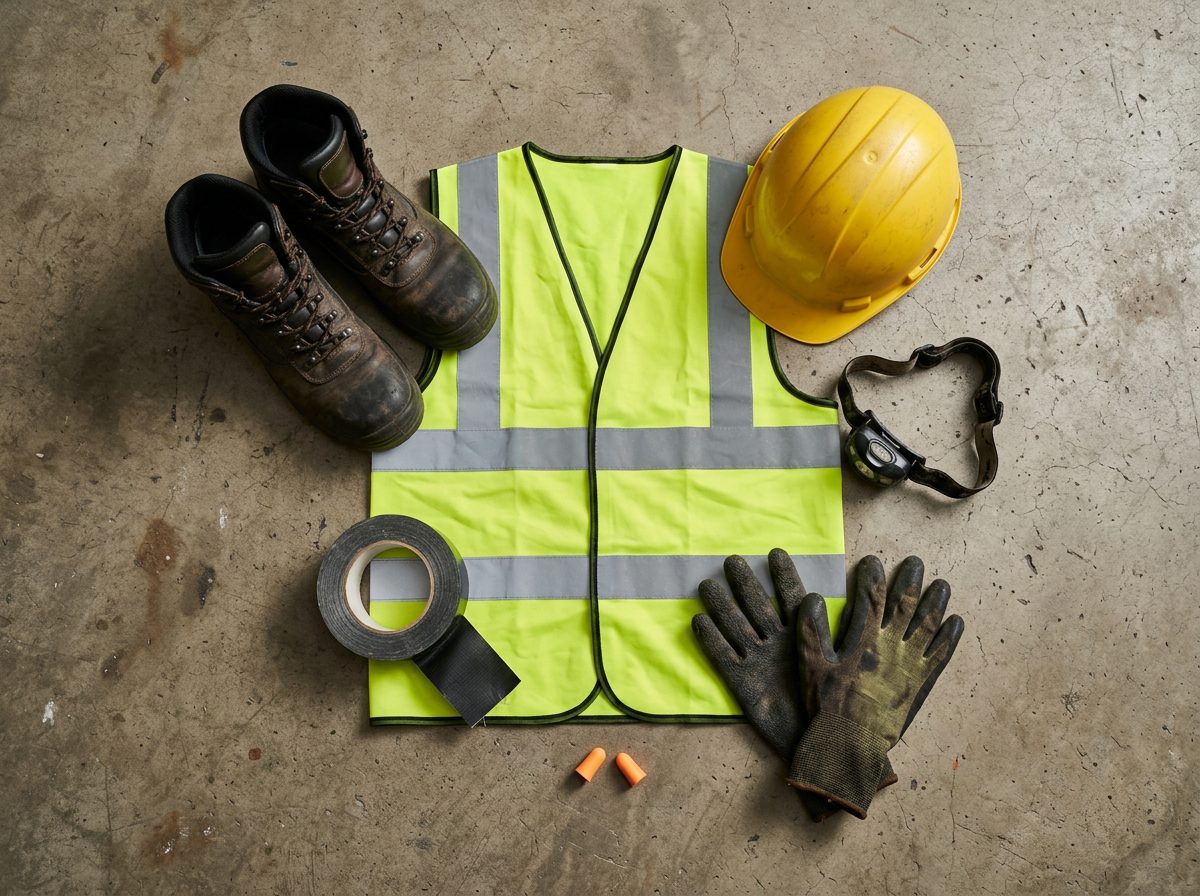
PPE means personal protective equipment. It is the last line of defence. It does not remove the hazard, it only softens the hit. That is why it comes after the other controls, but it is also why it must be worn the whole time the hazard is there. Your employer provides it. You wear it.
Safety boots
Steel or composite toe cap and a hard sole. A road case on a sandal ends a season. Boots are worn on every build, show and strike, not only when something heavy is moving.
Gloves
For cases, truss, cable and anything with sharp edges or pinch points. Take them off near spinning or rotating equipment, and when you need fine control.
Hi-vis
Worn during build and strike, when vehicles and forklifts move and people are rushing. A driver who cannot see you cannot avoid you.
Hearing protection
Earplugs or muffs when levels pass the limit (Lesson 7). Keep a spare pair in your pocket. They cost almost nothing.
Hard hat
Worn whenever someone is working overhead: rigging, lighting hangs, climbing a ladder above you. If it can fall on you, wear the hat.
Eyes and dust
Safety glasses for cutting, drilling and grinding. A dust mask in a dusty store or on a smoky strike.
Cracked hat, torn glove, split boot sole: hand it back and get a new one. Damaged PPE gives you a false sense of safety, which is worse than none.
04Manual handling
Lifting and carrying cause more crew injuries than anything else: sore backs, strained shoulders, crushed fingers. Sound kit is heavy and awkward. Back injuries build up over years and then end a career in one lift. The fix is technique and teamwork, not strength.
Rules for the heavy stuff
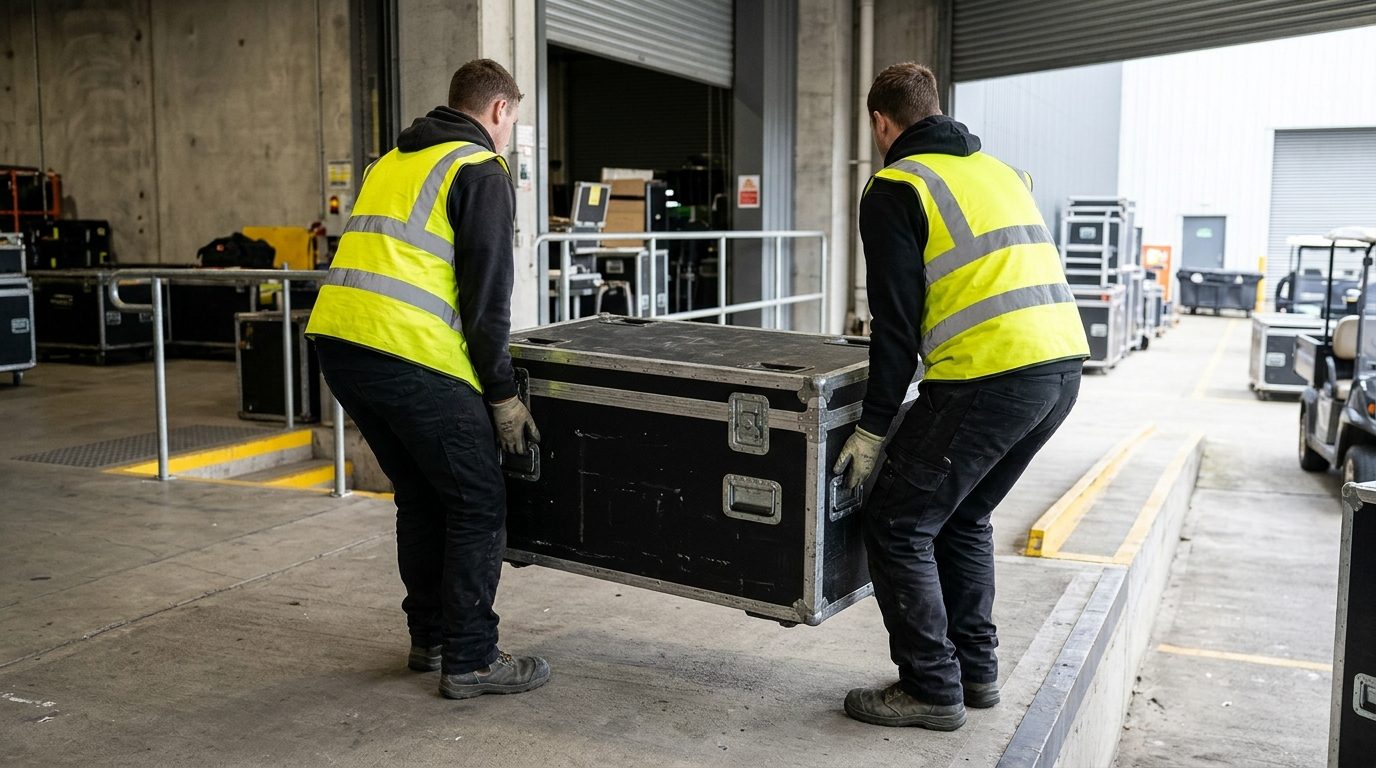
- Two-person lift for heavy boxes. Subs, amp racks and loaded cases are two-person jobs at the very least. If it will not move easily, get more hands.
- Use the wheels. Flight cases and racks have castors for a reason. Roll them. Do not carry what can roll.
- Ramps and trolleys. Use a ramp for the truck and a trolley or sack truck for stairs and long carries. Walk the route first and clear it.
- Call the lift. The person at the heavy end calls it, so you rise and walk together.
- Know your limit. Ask for help when you are tired. A load that was fine at 8 am is not fine at 11 pm.
- Fingers. Keep them out of hinges, case latches and between a box and the wall.
Team lift call
"Ready?" "Ready." "Lift on three. One, two, three." Walk in step. "Down on three." Always the same words, so nobody is surprised.
Stack limits
Stack heavy at the bottom, light on top. Never stack higher than you can reach to steady. Subs go on the floor, not on top of cases. Strap tall stacks in the truck.
Plan the path
Doors, steps, kerbs, wet floors, loose cables. If you cannot see your feet, you are carrying too much.
At B&W the heavy lifts are the JBL SRX828SP powered subs and the amp racks. Two people each, or the ramp and trolley. The music buses and the three sound trucks all carry ramps.
05Working at height
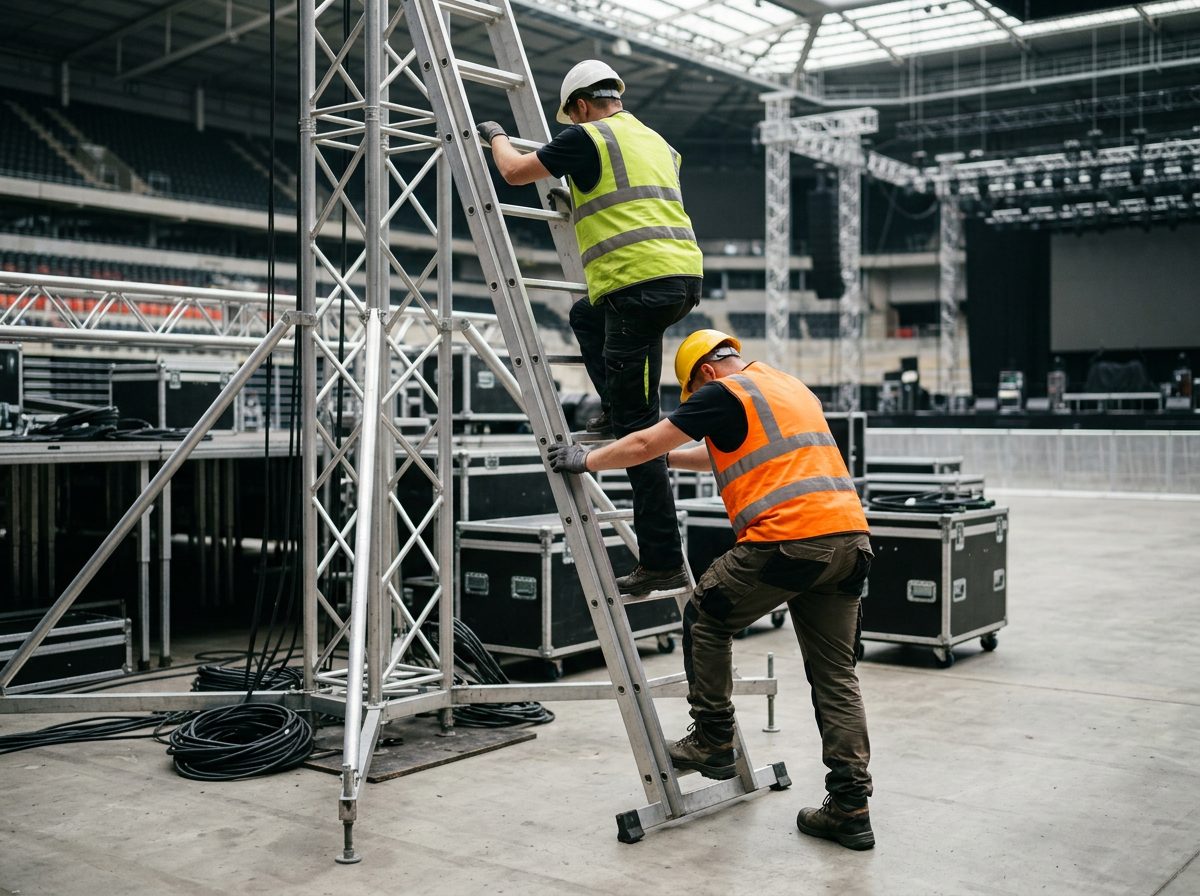
Falls from height are one of the biggest killers in the events industry. Two metres is enough to kill. On a normal event you will use a ladder, work near a stage edge, or be under someone else's overhead work. Know the rules for all three.
Ladder rules
- Check it first: no bent rails, no loose or missing rungs, rubber feet on.
- Firm, level ground. Never on a case, a box or a pile of rubble.
- Let the ladder reach at least 1 m above where you step off, if you are going onto a platform.
- Someone foots the ladder: hands on the rails, feet braced, eyes up, not on a phone.
- Never use the top rungs. Never overreach. If you cannot reach it, climb down and move the ladder.
- One person at a time. Do not use a ladder near live power or a doorway without a barrier.
B&W carries one ladder rack. Check the ladder before you take it off, and sign it back on the truck when you are done. Nothing is hung from it.
Truss, motors, speaker arrays and lights hung from above are rigged by a competent rigger, who checks the load, the points and the safety bonds. Crew do not improvise a hang from a beam, a tent pole or a ladder. Keep the exclusion zone empty while anyone works above it, and wear a hard hat if you must pass.
06Stands, stacks and wind
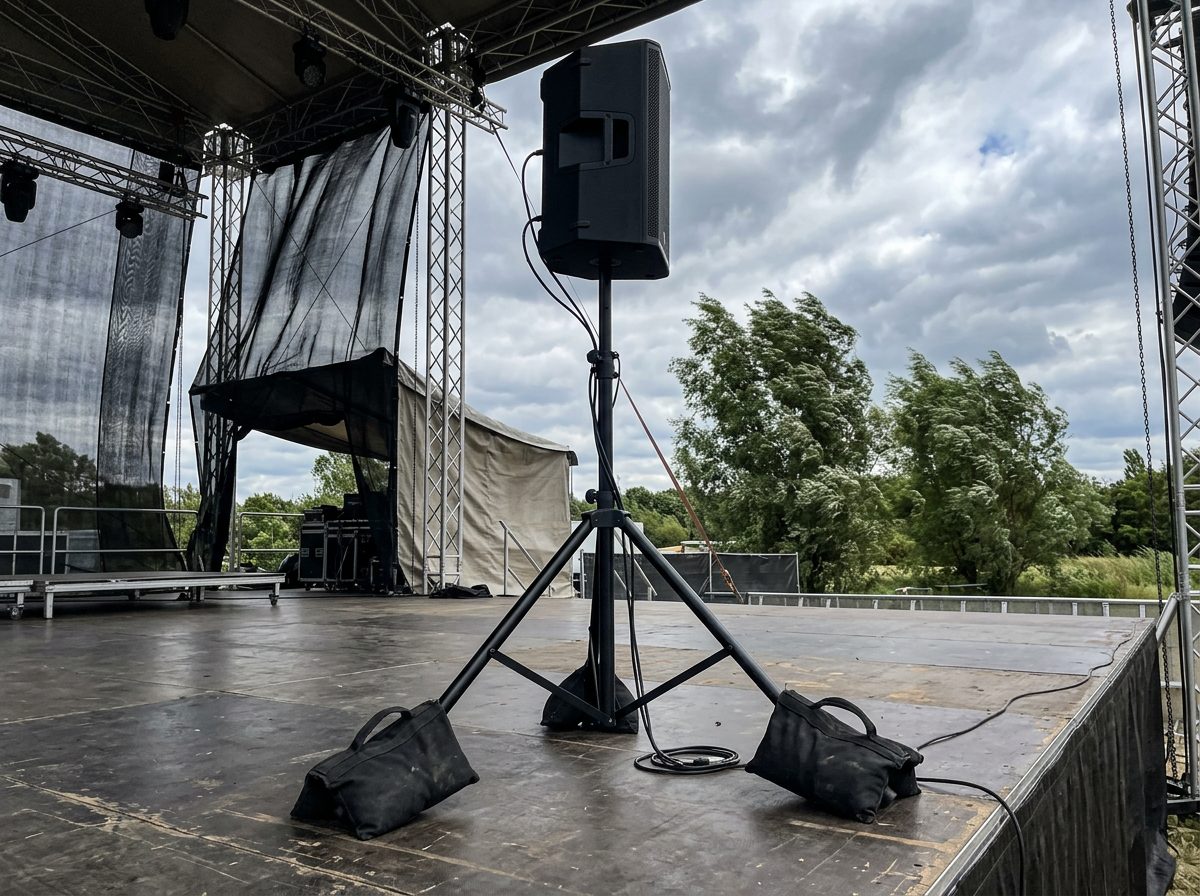
A speaker or a light on a stand is a heavy object on a tall, thin base. It takes one knock or one gust to bring it down onto someone. Every stand and stack is built to stay up on its own, even when nobody is touching it.
The rules
- Stands: legs fully out and locked. Pole pin or clamp locked. Fit the speaker onto the pole correctly, with the retaining pin or locking collar where the maker provides one.
- Sandbags: on the legs, or hung from the stand base, not just beside it. Use them every time, indoors and outside.
- Ground stacks: stay within the speaker maker's stack limit. Check the manual for how many subs high, and what can sit on top. Use the stacking feet and locating pins the box was built for.
- Strap columns: a stack of boxes or a column array is strapped with ratchet or cam straps to itself, or to a fixed point, not to a loose bag or a table.
- Keep the public away: nobody leans on, climbs on or props a drink on a stack. Put a barrier or a person between the crowd and the kit.
- Cables: never run a cable across a walkway to a stand without a ramp or tape. A tripped cable pulls the stand down.
Safety bonds on lights
Every light hung from a truss, T-bar or bracket has a safety bond: a steel wire loop that goes round the truss or bar and through the light's bond point. If the clamp fails, the bond catches the light so it hangs, not drops. Bond it every time, even for a "quick" light. A clamp is not a safety device. The bond is.
Do not wait for a stand to fall. If the wind makes tops sway, tents lift or banners snap, tell the crew chief and bring tall kit down. Tents, stages and roofs have a maker's wind limit. The rigger or crew chief follows it, even if the show is about to start.
07Noise
Loud sound damages hearing for good. You will not feel it happen. Your ears ring for a few hours, then they seem fine, and the damage stays. Event crew work next to speakers for years, and the loss adds up. The OHS rules set a limit to keep you safe.
85 dB(A) over an 8-hour working day. Above that, hearing protection. And every 3 dB louder halves the safe time: 88 dB(A) is 4 hours, 91 is 2 hours, 94 is 1 hour.
Try it: how long can I stay here?
Safe time = 8 hours × 2^((85 − level) ÷ 3). Use a phone SPL app set to A-weighting for a rough guide. The engineer's meter is better.
| Level dB(A) | Safe time per day |
|---|---|
| 85 | 8 hours |
| 88 | 4 hours |
| 91 | 2 hours |
| 94 | 1 hour |
| 100 | 15 minutes |
| 106 | about 4 minutes |
What to do
- Earplugs for crew any time the system is up and you are near it. Foam plugs: roll thin, pull the ear up, insert, hold for a few seconds. They seal when they expand.
- Do not stand in front of the subs. Low frequencies hit the chest and the ears hard, and the level close to a sub is far higher than at the mixing desk. Work from the side or behind, and take breaks away from the stack.
- Rotate and rest. Your ears need quiet to recover. Step outside between sets.
- Sound checks are loud too. Wear plugs when the system is being pushed, not only during the show.
08Electrical, fire and effects
Three hazards that can turn a good show into an emergency: electricity, fire and stage effects. Each has a simple rule about who may touch what.
Electrical: crew plug in, electricians wire in
You plug leads into distros, multiplugs and sockets. Qualified electricians wire distribution boards, change plugs and make any connection inside a box. If a lead is damaged, a plug is cracked, or a distro smells hot, do not open it and do not fix it. Tag it, take it out of use and tell the crew chief. Module 8 covers event power in depth.
Never open a plug, a distro or a board. Never wire in. Never work on a live system. Never use a lead with exposed copper, tape on the outer sleeve or a hot plug.
Fire
- Know where the extinguishers are and which type they are before the doors open.
- Use a CO2 extinguisher on electrical fires. Do not use water or foam on kit that is live.
- Fire exits are never blocked. Not by a road case, a stack, a trolley or a cable run. Keep the route and the door clear, and the sign visible.
- If you smell smoke or see flames, raise the alarm and follow the site plan. Only fight a fire if it is small, the exit is behind you and you have been trained.
Haze and smoke
Haze and smoke machines can set off smoke detectors, and an alarm will clear the whole building. The venue must know before you run a machine. Whether to isolate a detector is the venue's decision, made by the venue's safety officer, never yours. Do not cover a detector with a glove, a bag or tape.
CO2 jets
- Cylinders are strapped upright. A falling cylinder can snap its valve and become a missile.
- Liquid CO2 is very cold. A jet or a loose hose can give a cold burn. Never touch the nozzle, hose or valve while in use.
- Jets are aimed away from faces, with a clear zone in front of them, and aimed up or away from people.
- Only trained operators run them. If you have not been trained, you do not touch the controls.
B&W runs 4 CO2 jets and 4 smoke machines. Only the trained B&W operator runs them, and the venue is told before any machine is switched on.
09Weather and lightning
Most events are outdoors or in tents, and South African weather swings hard. A hot Highveld afternoon can end in a hail storm. Weather is a safety job, not only a comfort job.
Hot sun
Water in your bag and a drink every hour, in the shade. Sunscreen, a hat, covered shoulders. Dizziness, headache or cramps: stop, cool down and tell the crew chief. Heat exhaustion creeps up during a long build.
Rain
Water and power do not mix. Power off wet kit. Keep connectors off the ground and covered. Do not plug in with wet hands or into a wet socket. Wait until the kit is dry and checked.
Cold and wet
Wet crew get slow and clumsy. Rain gear, a spare dry top, hot drink in the break. Stages and ramps get slippery: slow down.
Lightning: the 30-30 rule
Lightning kills people at events. Stages, towers, trusses and tall stands attract it, and so does the crew standing on them. Count the seconds from a flash to the thunder. Sound travels about 1 km in 3 seconds.
- Count from flash to thunder. Under 30 seconds means danger.
- Stop work at height and on stage. Climbing down comes first. Do not finish the job.
- Get inside a solid building or into a vehicle with a metal roof and windows up. A tent is not shelter from lightning.
- Power down if the crew chief calls for it, but only if that is safe. Never touch kit or plug in during a close storm.
- Wait 30 minutes after the last thunder. If thunder comes again inside that window, the clock restarts.
The client and the organiser may want to carry on. The weather call belongs to the site safety lead and the crew chief. If you are told to climb during a close storm, say no and say why.
10Vehicles, loading and emergencies
The loading bay is where crew get hit by trucks, trolleys and falling cases. It is also where the day starts and ends, when you are fresh, then exhausted. Keep it organised, and know exactly what to do when something goes wrong.
Loading and vehicles
- Reversing needs a spotter. Hi-vis on, in the driver's view, never directly behind. Agree the signals first: stop means stop at once, hand up.
- Engine off, handbrake on when loading and unloading. Chock the wheels on a slope.
- Load straps. Everything in the truck is strapped or blocked. Heavy low and forward, light on top. Check straps at the first stop. A free-rolling case on a braking truck kills.
- Know the truck weight. The vehicle has a rated load. Do not overload it: it brakes badly and handles dangerously. If you are unsure, ask the driver or the crew chief.
- Ramps and tail-lifts: hands and feet clear of the platform edge. No passengers on the tail-lift.
- Forklifts and carts: assume the driver has not seen you.
B&W's 3 sound trucks and music buses are loaded by the crew chief's plan, strapped and weight-checked. Reversing at the venue always has a named spotter.
Alcohol, drugs and fatigue
Zero alcohol and drugs while on duty. That includes the last hours of a long strike, "just one" after the show, and leftover stock at an open bar. Impairment is how kit and people get hurt. Fatigue works the same way: after a 16-hour day, your judgement, grip and reaction time are all down. Tell the crew chief when you are exhausted. Do not drive home half asleep: sleep, share a lift or ask for a rest.
When someone is hurt
10111
Police.
10177
Ambulance.
112
From a cell phone. It connects to the emergency services from any network.
- First aid kit: know where it is. Use it for minor cuts and scrapes. Report what you used so it gets replaced.
- Serious injury: call for help, send someone to meet the ambulance at the gate, do not move the person unless they are in danger, and stay with them.
- Injury report: every injury, even a small one, goes in the injury report. Write down what happened, where, when and who saw it. Report near misses the same way.
Site safety checklist
Run through this at the start of every call. It takes two minutes.
- Induction done
You attended, you know the exits, first aid point, vehicle routes and emergency signal. - PPE on
Boots, hi-vis for build and strike, gloves in the pocket, hearing protection to hand. - Walk the area
Look up, down and behind. Anything that could hurt someone is flagged to the crew chief. - Heavy lifts planned
Two people, wheels, ramps and trolleys ready. Route clear. - Height rules agreed
Ladder checked, someone footing, exclusion zone taped. Overhead work is the rigger's alone. - Stands and stacks secure
Legs out, locked, sandbagged. Stacks strapped. Safety bonds on every light. - Exits and fire kit
Fire exits clear. You know where the extinguishers are. Venue told about haze, smoke and CO2. - Weather checked
Wind, rain, heat and storm plan agreed. Water and shade available. - Vehicles and loading
Spotter named, loads strapped, weight checked, pedestrians kept clear. - Emergency known
First aid kit located, numbers on your phone (10111, 10177, 112), crew chief's number saved. Fit for duty: no alcohol or drugs, and you slept.
11Check what you learnt
Ten questions. Pick an answer for each, then press Mark my answers. You need 8 out of 10 to pass this module. You can retry as often as you like.
Ten questions. Circle one answer for each. The answer key is on the last page. Pass mark: 8 out of 10.
Answer key
Photos: product images courtesy of the manufacturers (RCF, Neutrik) and their distributors; scene photographs are AI-generated illustrations and do not show B&W Productions equipment or events.