01The load sheet: what your kit actually draws
Module 5 taught you amps = watts ÷ 230. This lesson is the next step: write down every item that will be plugged in, find its real draw, and work out the supply before you leave the warehouse. That list is the load sheet. A load sheet that is wrong by a few kilowatts is how a show goes dark at 20:00.
Running watts and inrush
Every item has two numbers. Running watts is what it draws once it has settled. Inrush is the surge at the moment of switch-on. Amplifiers, powered speakers and the motors in moving heads can pull several times their running current for a fraction of a second. A breaker sees that surge. Switch ten items on together and the surges stack on top of each other.
Biggest and most surge-prone first: amp racks and subs, then tops, then moving heads, then LED PARs, then catering. A few seconds between groups. Never throw every breaker at once.
Typical draws
These are planning ranges, not specs. Your own kit has a label or plate with the real number. Check the label and use that. When the label gives a maximum, remember most kit runs well below it, so the label is the safe side of the sum.
| Category | Typical running draw | Switch-on surge | Note |
|---|---|---|---|
| Powered top | 200 to 600 W | Noticeable | Draw climbs with volume. Label shows the maximum. |
| Powered sub | 400 to 1 000 W | Noticeable | The biggest sound load per box. |
| Amp rack | 500 to 2 000 W | High | Depends how hard it is driven. Use the plate. |
| LED PAR | 40 to 150 W | Low | Many small loads add up fast. |
| Moving head | 150 to 400 W (LED); 400 W up for lamp types | High | Motors reset all at once at power-up. |
| Haze or smoke machine | 500 to 1 500 W | None (heater) | Heater load while warming up. |
| Tea urn | 2 000 to 3 000 W | None (heater) | Steady and big. One urn is a whole 16 A circuit. |
| Laptop, DJ gear | 100 to 400 W | Low | Small, but it must never lose power. |
B&W habit: the PA (amp racks, tops and subs) goes on its own phase, lighting and effects on another, and catering and heaters on the third.
Try it: build a load sheet
Pick a quantity for each item and the phase it plugs into. The tool adds it up and tells you the smallest supply that fits at 80%. Values are mid-range planning figures: replace them with the label on your own kit.
| Item | Planning W each | Qty | Phase |
|---|---|---|---|
| 400 | |||
| 600 | |||
| 1500 | |||
| 80 | |||
| 250 | |||
| 800 | |||
| 2000 | |||
| 200 |
| Supply | Working limit (80%) | Rule used |
|---|---|---|
| 16 A single-phase | 12.8 A | Total amps |
| 32 A single-phase | 25.6 A | Total amps |
| 32 A three-phase | 25.6 A per phase | Worst phase |
| 63 A three-phase | 50.4 A per phase | Worst phase |
Example: 3 subs and 4 tops on L1 (14.8 A), 12 PARs and 6 moving heads on L2 (10.7 A), a haze machine, an urn and 2 laptops on L3 (13.9 A). Total 40.3 A, worst phase 14.8 A: fits a 32 A three-phase supply. The phases are within 30% of each other.
02Sockets, multiplugs and couplers: not overloading
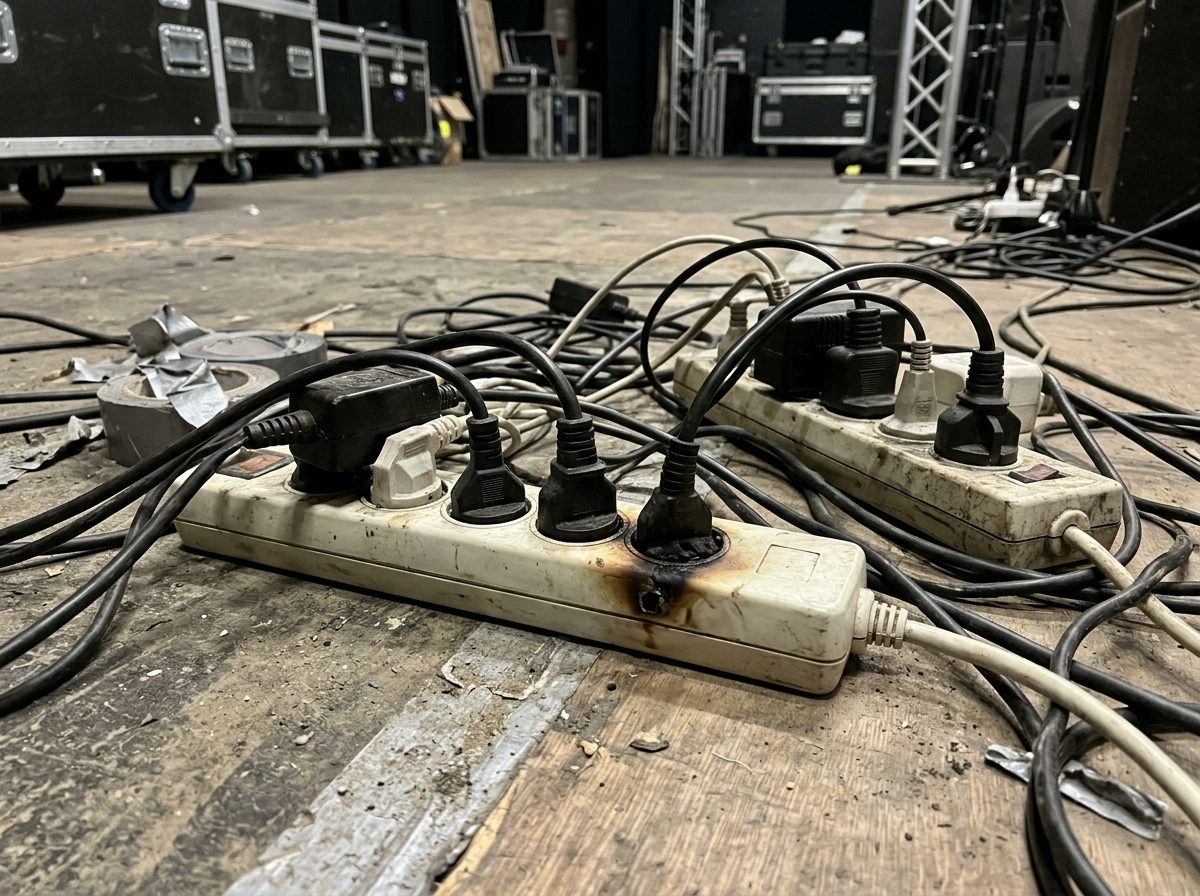
Most overloads are not at the generator. They are at the last few metres, where one cheap multiplug feeds far more than it can carry. The rule is simple: every joint in the chain is only as strong as its weakest part.
The rules
- A multiplug is rated by its plug. A 16 A multiplug in a 32 A distro outlet is still a 16 A multiplug. The 32 A breaker will not save it. Add up the amps on the multiplug (watts ÷ 230) and keep it under 12.8 A.
- Never daisy-chain multiplugs. A multiplug into a multiplug adds a joint and adds load to a plug that was never rated for it. Go back to the distro for another outlet.
- Wall sockets share one circuit. Four wall sockets in a hall may all sit on the same 16 A breaker. Ask the venue, or treat the whole wall as one circuit. Plugging a urn into the next socket does not give you a second 16 A.
- Unwind a cable reel fully. A coiled reel under load cannot lose its heat. Its rating when wound is much lower than when unwound. The label shows both numbers.
- Heat at a plug means stop. A plug or multiplug that is warm, discoloured or smells of hot plastic gets switched off, unplugged and tagged. Find out why before it goes back.
Never fit a bigger breaker or fuse to stop trips. The trip is telling you the load is too big for that circuit. Move load to another outlet or another phase.
03The chain on site
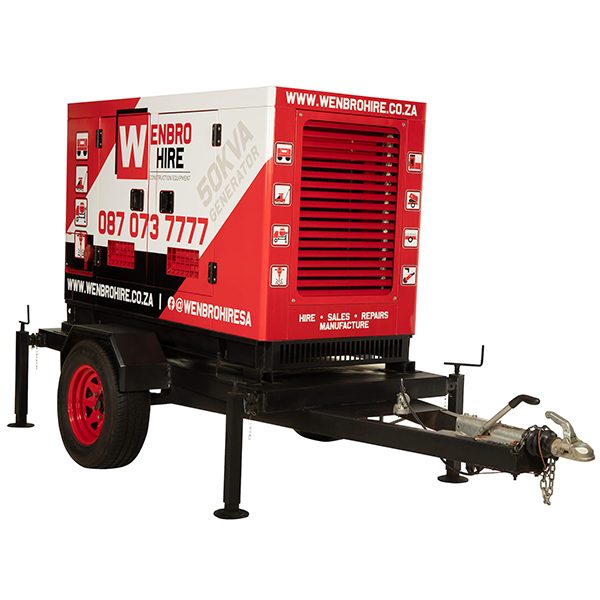 Trailer generator, 63 A red outlet
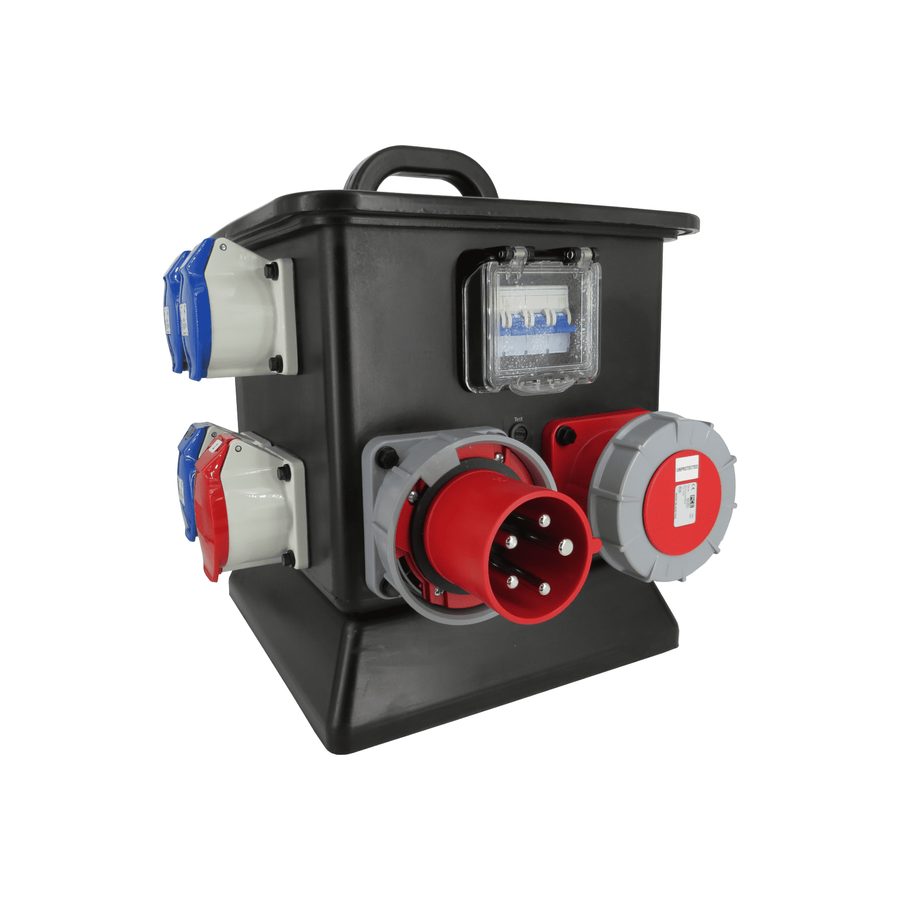 63 A three-phase distro, 32 A outputs
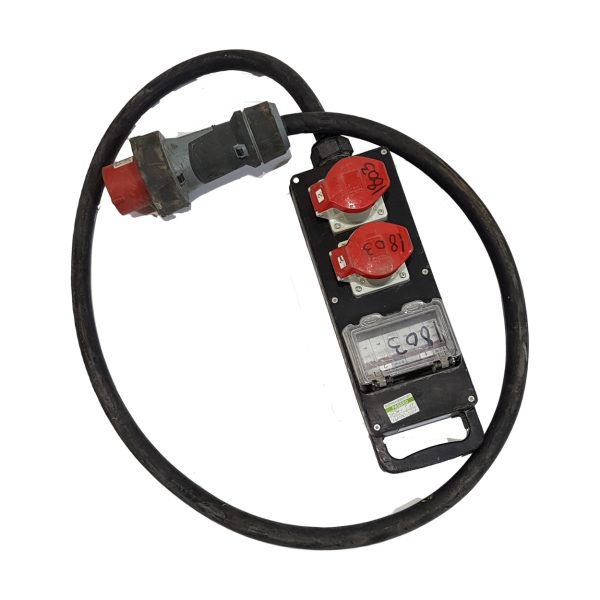 63 A to 2 × 32 A splitter
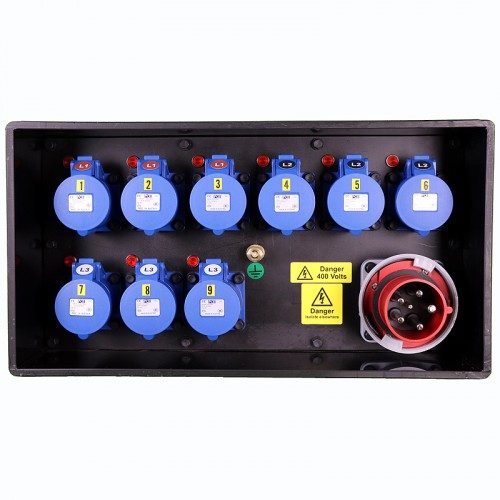 32 A distro to 16 A outlets
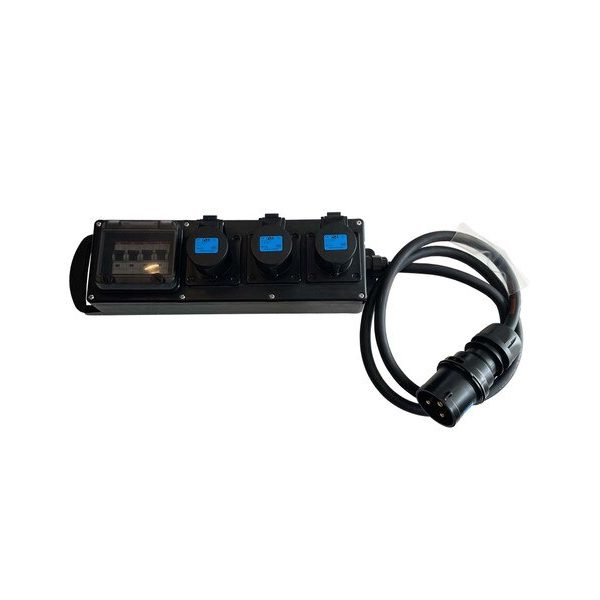 32 A to 3 × 16 A inline distro
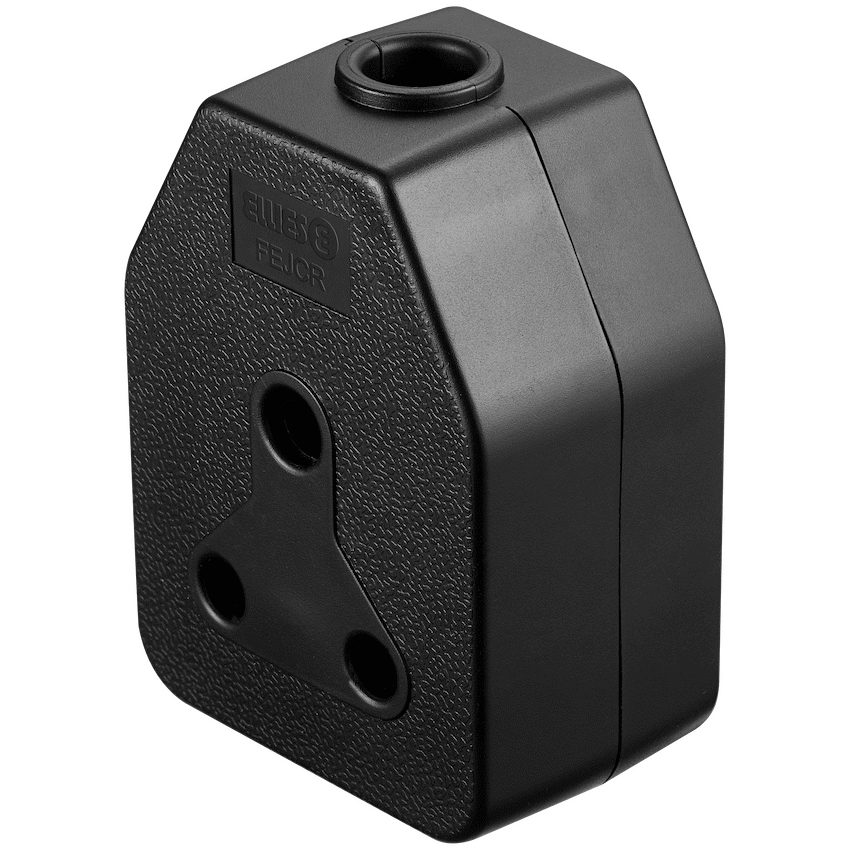 Janus coupler, last metre
Power always steps down: big and protected at the source, smaller and protected again at every step. Know what each link is rated for and you know what it can carry. This is the chain you will build on most jobs.
In the B&W kit: the generator's 63 A red five-pin outlet into a 63 A distro (one 63 A inlet, four 32 A three-phase outputs, an ammeter per phase on the front), red 32 A five-pin leads to the 32 A distros (a 32 A three-phase inlet, 15 plug-top outlets, five per phase, each with its own trip switch), multiplugs off those outlets, and Janus couplers on the last metre.
Adaptors: what is allowed
| Allowed | Never |
|---|---|
| Bigger supply to a smaller one, when the smaller one has its own protection. A 32 A distro outlet down to a 16 A lead is the normal case. | A small plug into a bigger socket. A 16 A lead pushed into a 32 A feed with an adaptor carries 32 A in a 16 A cable. |
| A purpose-made adaptor that is the same make as the connectors, undamaged and tagged. | Home-made adaptors, cut-off plugs, "temporary" wiring, a plug with the pins bent to fit. |
| The lead whose plug matches the socket. Colour and pin count match, so it only fits where it belongs. | Forcing a plug that does not fit. If it does not fit, it is not meant to be used there. |
Add up the amps on each multiplug. Add the multiplugs on each 32 A distro. Add the 32 A distros on the 63 A distro. At every step the total must be under the rating, and under 80% of it.
04Water and weather
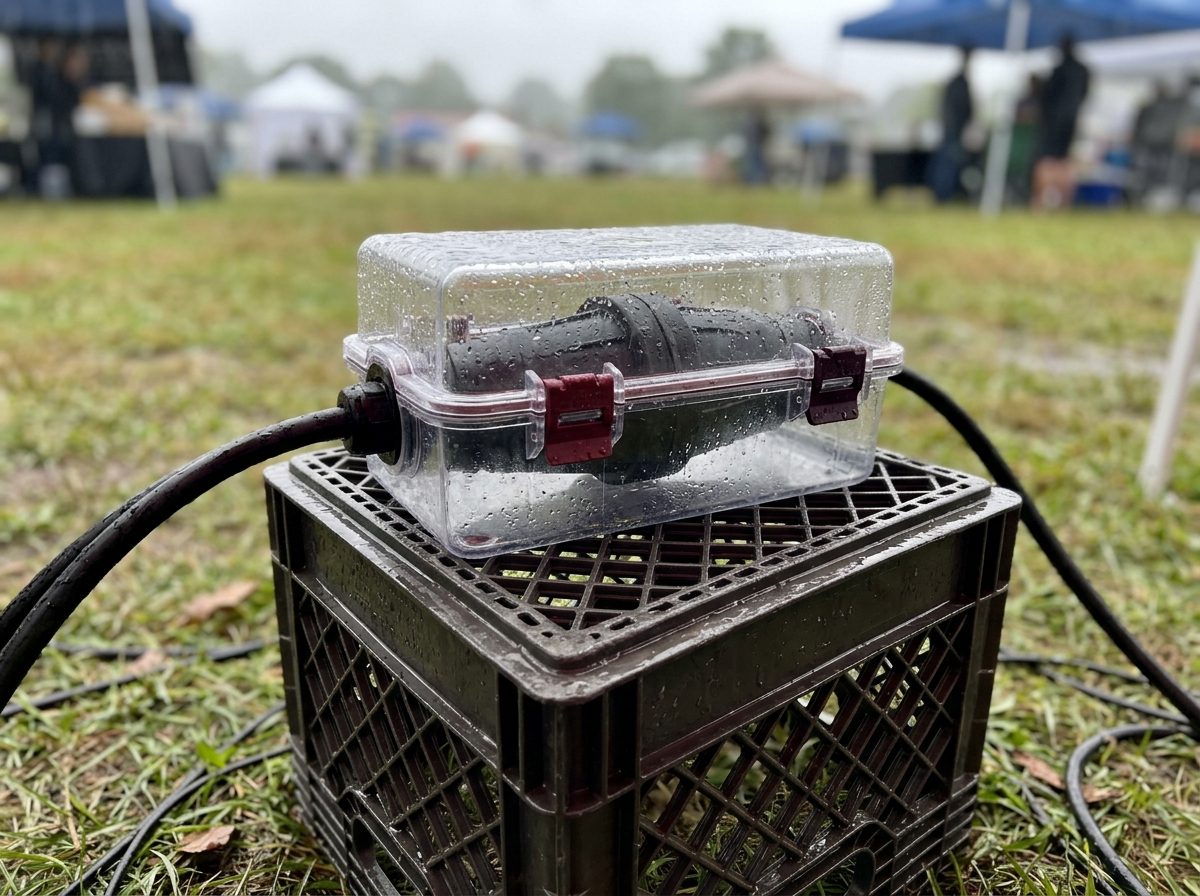 Joint in a cover box, off the ground
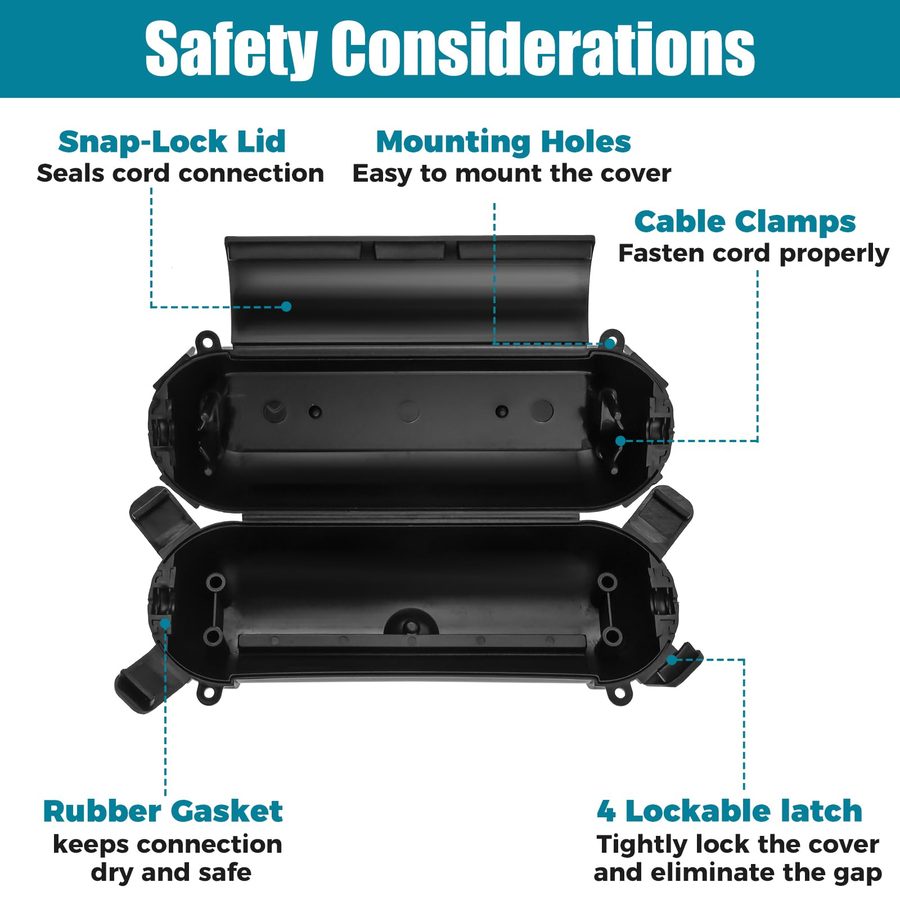 IP44 coupler cover box
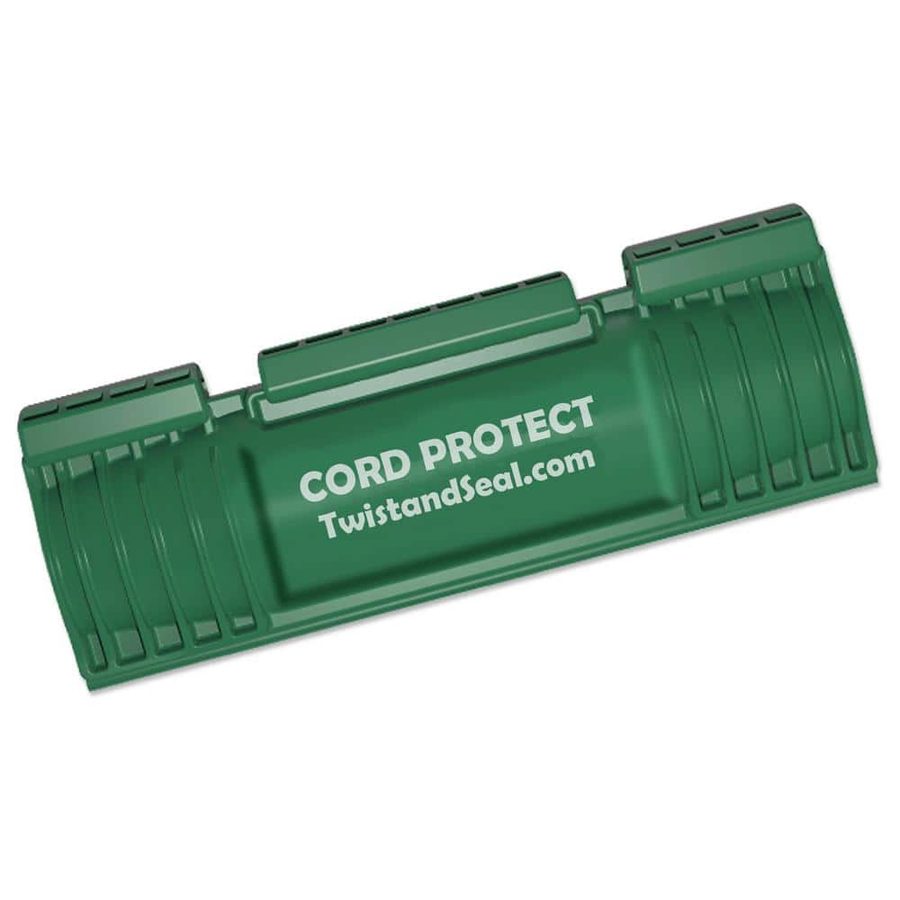 Clip-on cable joint cover
Water and power kill. Rain, a leaking tent, a watered lawn or a cooler box of melting ice all find the joints in your chain. Plan for water before it arrives. The rating on a piece of kit tells you what it was built to survive.
IP ratings
| Rating | Means | Use it for |
|---|---|---|
| IP20 | No water protection | Indoors, dry, under a roof only |
| IP44 | Splash-proof | Covered outdoor use, a light drizzle on a covered stage |
| IP65 | Dust-tight, water jets | Outdoor lights that get rained on |
| IP66 | Dust-tight, powerful jets | Heavy rain and hosing down |
| IP67 | Dust-tight, temporary immersion | Kit that may sit in a puddle for a short while |
Joints are the weak point
A plug and socket joint is the least waterproof part of your chain, whatever the equipment says. Janus rubber couplers are not waterproof. They stop fingers touching live pins. They do not stop water running in.
- Cover box: every joint outdoors goes in a coupler cover box with the lid closed.
- Lift it: joints sit on a crate or bricks, never on the ground.
- Drip loops: let each cable hang below the joint before it rises to it, so water drips off the low point.
- Not in a puddle path: look where rain will run. A slight slope moves water across your cable run.
- Close the caps: CEE caps shut on every unused socket.
- Distros up: on pallets or stands, lids closed, under cover.
- Rain plan: before the event, decide where distros and joints go if it rains, and who moves them.
- Last resort only: a plastic bag taped over a joint keeps off splashes for a short while and traps condensation. It is not a fix.
At B&W the Janus couplers on the last metre are rubber like any other: they get a cover box, a crate and a drip loop, and they are never left in a wet path.
Switch off at the source. Do not touch it while it is live. Tag it. A qualified electrician checks it before it is used again, even if it looks dry.
05Generator sizes: 20, 30 and 50 kVA
50 kVA trailer set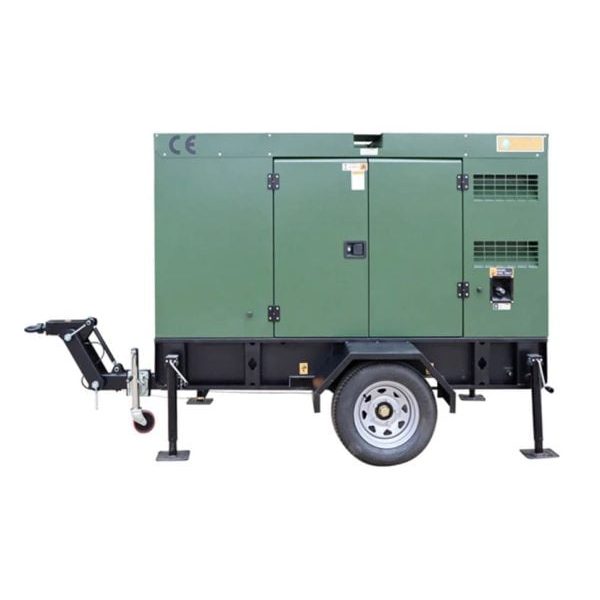 50 kVA silent canopy set
A generator sets the ceiling for the whole event. Pick one too small and the show trips. Pick one far too big and the engine suffers. The numbers below get you close; the plate and the hire company give the exact figures.
- kVA × 0.8 = kW. A 20 kVA set gives 16 kW. A 30 kVA gives 24 kW. A 50 kVA gives 40 kW.
- Plan to use about 70%. That leaves room for surges, a late-added urn and a hot day.
- The Highveld takes power away. At about 1 500 to 1 800 m the engine breathes thinner air. Budget roughly 10% less than the rating, and more in summer heat. This is a rule of thumb: the manufacturer's derating table is the real number.
- Never run a diesel below about 30% load for long. A lightly loaded diesel does not get hot enough, so unburnt fuel and soot build up in the exhaust. That is wet stacking: black smoke, soot, lost power and a ruined engine over time.
| Set | kW (kVA × 0.8) | On the Highveld (about −10%) | Plan for 70% of that | Under-loaded below 30% |
|---|---|---|---|---|
| 20 kVA | 16 kW | 14.4 kW | 10.1 kW | 4.3 kW |
| 30 kVA | 24 kW | 21.6 kW | 15.1 kW | 6.5 kW |
| 50 kVA | 40 kW | 36 kW | 25.2 kW | 10.8 kW |
B&W has 20, 30 and 50 kVA generators, each as a single-phase or a three-phase unit. Read the plate on the set in front of you before you plan the load.
Try it: size a generator
Rated kW = kVA × 0.8. Highveld takes off about 10%, a hot day about another 5% (rule of thumb: use the maker's table). Plan for 70% of what is left. Under 30%, a diesel is at risk of wet stacking. Example: 30 kVA, three-phase, Highveld, 12 kW load: 24 kW rated, 21.6 kW usable, 56% loaded: good band.
06Single-phase vs three-phase generators
The same kVA can be delivered two ways. A single-phase set gives you one supply. A three-phase set gives you three. Which you have changes how you plan the load.
Single-phase set
One 230 V supply. All the load is on one line, so the total amps are the line amps. Simple, and fine when the total load is small. The distro just splits that one line into outlets.
Three-phase set
Three 230 V lines (L1, L2, L3) and 400 V between any two of them. Each line carries a third of the set. You must spread the load across the three lines.
Why balance matters
On a three-phase set each line can only give about a third of the rating. A 30 kVA set gives roughly 10 kVA per line. Overload one line and it sags or trips while the other two have room to spare. The set looks half empty and still fails. A badly unbalanced load also makes the voltage on the loaded line drop, and that is when amplifiers clip early and lights flicker.
Reading the three ammeters
A three-phase distro with meters on the front shows one reading per phase: L1, L2 and L3. Each meter shows the amps that phase is carrying right now. That is your load sheet, live.
- Each phase on its own: stay under 80% of the breaker. On a 63 A distro that is about 50 A per phase.
- Phases against each other: aim to keep the three readings close. If one reads more than about double the lightest, move a load across.
- When to read: after each area is switched on, at full show level, and again when the catering heats up.
- Moving a load: unplug the item from a socket on the heavy phase and plug it into a socket on the light phase. On a 32 A distro the outlets are already grouped by phase, so this is a plug swap, not a wiring job.
On the B&W 63 A distro the three meters are on the front. Read them after each area comes on. The B&W 32 A distros have no meters, but their 15 outlets are grouped five per phase with a trip switch each, so you balance by choosing which group an item plugs into. Remember the sum: five 16 A outlets on one phase still share that phase's 32 A. Five urns on one phase will trip it.
A sensible split
- Phase 1: sound. Amp racks, powered tops and subs, mixer, DJ.
- Phase 2: lighting and effects. LED PARs, moving heads, haze.
- Phase 3: catering and heaters. Urns, slush machines, fridges. Heaters are the biggest and steadiest loads.
Keeping sound on its own line also keeps lighting dimmers and heater switching away from the audio. Label each outlet with its line (for example "L2 · lights").
A small PA, a few lights and a laptop: total under about 10 A and nothing heavy like an urn on it. If you need to ask whether single-phase is enough, run the load sheet from Lesson 1. If the total is over 25.6 A, you want three-phase.
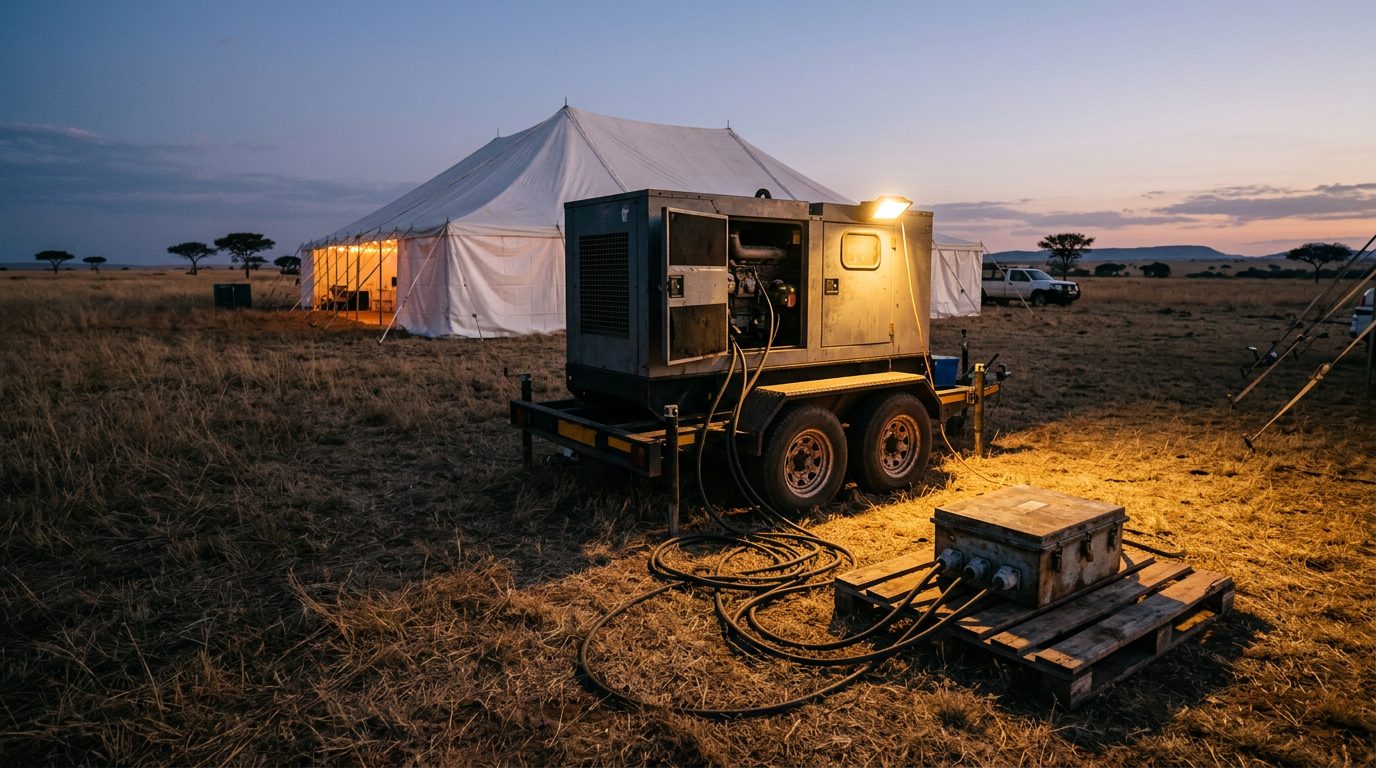
07Running a generator on site
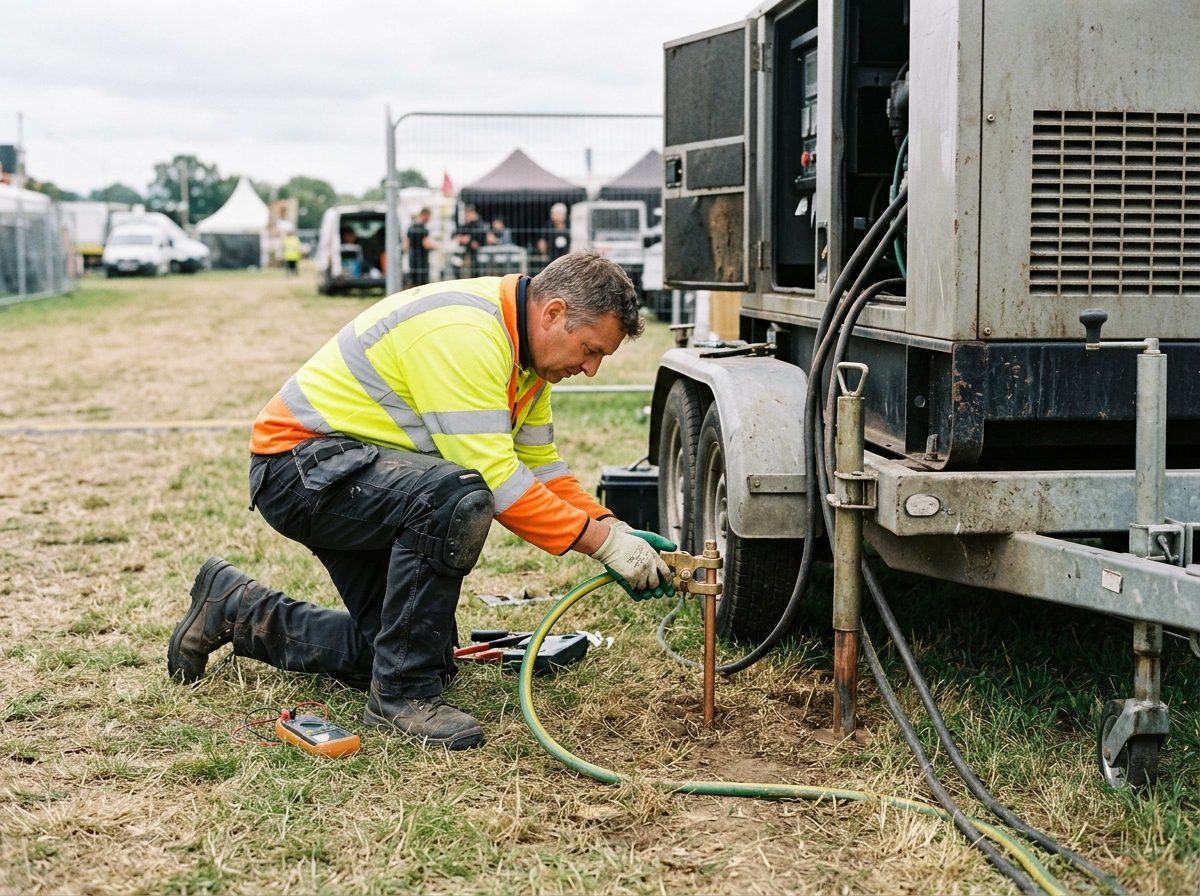
A generator is a running engine in a public space. It makes noise, heat and a poisonous gas. Most trouble comes from where it stands and how it is started and stopped.
Exhaust has carbon monoxide: you cannot smell it and it kills. Never run a generator in a closed space, a tent, a container or a garage, and never where the exhaust can blow into one.
Placement
- Level ground, with a drip tray. A tilted set can starve of oil or fuel.
- 10 m from guests for noise and fumes. More if the site allows.
- Exhaust downwind and pointing away from tents, guests and the stage.
- Cordon it. Barrier tape or fencing, a sign, nobody inside who is not on the power crew. The engine and exhaust are hot.
- Earth spike: the electrician installs and checks it. Crew never remove or move it.
- Extinguisher (CO2 or dry powder) on a stand beside it, in reach without walking through the cordon.
On a B&W job the electrician decides where the generator stands and earths it. Crew cordon it, fuel it and watch it.
Fuel at a glance
A diesel set at a decent load uses roughly 0.3 litres per kWh of load. The set's own data plate or the hire company gives the real figure. Example: a 15 kW load for 10 hours is about 15 × 10 × 0.3 = 45 litres. Add a 25% reserve and fill to at least that before the event starts. Refuel only when the set is stopped and cool. Fuel on a hot exhaust is a fire. Never let it run dry: it also stalls the engine and can need bleeding.
Start-up and shutdown
- Check fuel, oil and coolant. Confirm the earth spike is in place.
- Main breaker off. Start the engine with no load. Let it warm up for a few minutes.
- Switch on in groups (Lesson 1): main breaker, then distros, then kit in the order you planned.
- Check the percentage load stays in the good band (Lesson 5).
- Shutdown: kit off, distros off, main breaker off. Let the engine run unloaded for a few minutes to cool, then stop it. Never stop a diesel under load.
08Earth leakage and protection
Two different devices protect you, and they trip for different reasons. Knowing which one tripped tells you where to look.
| Breaker (MCB) | Earth leakage (RCD) | |
|---|---|---|
| Trips on | Too much current: overload or short circuit | Current leaking to earth, often through a person or water |
| Protects | The cable and kit from overheating | People from shock |
| Typical trip level | Its rating: 16 A, 32 A, 63 A | 30 mA on the 16 A outlets |
| Usual cause | Too much on one outlet, a damaged lead | Wet plug, damaged lead, faulty kit |
On B&W distros every outlet group has its own trip switch. Know which switch feeds which outlets before the show, and test the earth leakage button where the distro has one. A distro with no earth leakage on its 16 A outlets goes to the crew chief before anything is plugged in.
Test, then trust
- Test button before the event. With the distro live, press the TEST button on each earth leakage unit. It must trip. Reset it. If it does not trip, the unit is faulty: out of service.
- Nuisance trips. The trip may be real. Find the faulty item one at a time: switch off, unplug everything on that outlet, reset, then plug items back in one by one. When it trips again, you have found it. Swap that lead or item.
- Never bypass or tape a breaker. Not to finish the sound check, not "just for the first set". A tripped device is doing its job.
Reset once. If it trips again, find the cause. If you cannot find it, switch off and call the engineer or the electrician.
09Who does what, legally
Event power is covered by law in South Africa. The rule on site is short: crew plug in, electricians wire in.
Crew
Place distros. Lay leads. Plug into the right socket, switch on in groups, watch for heat, trips and damage, and report faults. Fill and watch the generator.
Registered electrician
Anything wired: tails, a distribution board, a generator hook-up that is not a plug, the earth spike, repairs inside a plug or distro. They also sign for the installation.
- Certificate of compliance. Under the Electrical Installation Regulations, an electrical installation must have a certificate of compliance. A temporary event installation is still an installation. The electrician who did the wiring issues the certificate.
- SANS 10142-1. This is the wiring code that installations are tested against. You do not need to know it. You need to know it exists and that only a qualified person works to it.
- Damaged equipment is tagged and goes out of service. Nobody repairs it on site.
If you wire in and something goes wrong, you may be personally liable, and insurance may not cover it. If you plug in and report a fault, you have done your job.
10Pre-show power checklist and fault table
Run this list for every event. Tick each item as you check it. It takes ten minutes and finds most problems before the guests arrive.
- Load sheet done
Every item listed, watts and amps worked out, supply chosen at 80%, phases within 30% of each other. - Generator sized and placed
Right size for the load in the good band (30 to 70%), level ground, 10 m from guests, exhaust downwind, cordon up, extinguisher beside it. - Fuel
Enough for the whole event plus a reserve. Refuel plan agreed: stopped and cool only. - Earth spike confirmed
Installed and checked by the electrician. Not touched by crew. - All leads inspected
No cuts, crushed sections, bent pins or loose glands. Damaged ones tagged out. - Multiplugs checked
Each under 12.8 A, none chained, reels fully unwound. - Joints protected
Cover boxes on, lifted off the ground, drip loops, away from puddle paths, CEE caps closed on unused sockets. - Earth leakage tested
TEST button on every unit trips and resets. - Outlets labelled by phase
L1 sound, L2 lighting and effects, L3 catering and heaters. - Power up in groups
Generator no load, main, distros, then kit: amp racks and subs, tops, moving heads, PARs, catering. Percentage load checked at the end.
If it is wrong
| Symptom | Most likely | Check |
|---|---|---|
| Breaker trips at switch-on, holds when you try again | Surges stacked: too much switched on at once | Power up in groups; biggest first |
| Breaker trips after a while under load | Overload on that outlet | Add up the amps on that outlet; move kit to another outlet or phase |
| Earth leakage trips as soon as one outlet is switched on | Wet or damaged lead or kit on that outlet | Unplug everything on it, reset, plug back in one by one |
| Earth leakage trips when rain starts | Water in a joint | Cover boxes, lifted joints, drip loops; dry and electrician-check any joint that was wet |
| Plug or multiplug warm | Overloaded or loose | Switch off, unplug, tag, shed load |
| One phase dead, others fine | Phase breaker tripped or unbalanced overload | Check that phase's breaker and load; rebalance |
| Lights dim and amps clip as the urn boils | Voltage sag on a loaded phase | Move the urn to its own phase; check generator percentage |
| Black smoke, soot, power seems low | Wet stacking: generator under-loaded | Add load or swap to a smaller set |
| Generator hunts, surges or stalls | Overloaded, switched on too fast, or low on fuel | Shed load, restart in groups, check fuel |
Sum the load, spread the phases, stay under 80%, keep joints dry, switch on in groups, and let the electrician do the wiring.
11Check what you learnt
Ten questions. Pick an answer for each, then press Mark my answers. You need 8 out of 10 to pass this module. You can retry as often as you like.
Ten questions. Circle one answer for each. The answer key is on the last page. Pass mark: 8 out of 10.
Answer key
Photos: product images courtesy of the manufacturers (RCF, Neutrik) and their distributors; scene photographs are AI-generated illustrations and do not show B&W Productions equipment or events.