TL;DR
Event planning follows seven stages: concept, feasibility & budgeting, planning & design, supplier procurement, coordination & logistics, execution, and post-event review. Follow all seven and your event runs smoothly from brief to debrief.
Key Takeaways
- Stage 1 (Concept) sets the objective — every subsequent decision flows from it.
- Stage 2 (Feasibility) kills bad ideas early and locks the budget before spend begins.
- Stage 5 (Coordination) is where most DIY events fall apart — logistics need a dedicated lead.
- Stage 7 (Post-event Review) closes the loop with ROI measurement and supplier debriefs.
Every event — whether it’s a 40-person product launch or a 5,000-delegate festival — moves through the same seven stages. The scale changes; the sequence doesn’t. After 33 years and 10,000+ events, B&W Productions has refined this framework into the backbone of every project we deliver. Here’s what each stage involves, what it produces, and where most events go wrong.
Stage 1: Concept and Objectives
This is where you answer the question: why does this event exist? Every decision that follows — budget, venue, format, guest list, marketing — is downstream of this answer. A product launch exists to generate sales leads. A year-end function exists to recognise and retain staff. A conference exists to transfer knowledge and build industry positioning. A gala dinner exists to deepen client relationships.
Deliverables: a one-page event brief containing the objective, 2–3 measurable KPIs, the target audience, the preferred date window, and an indicative guest count. This document is the anchor for the entire project.
Common mistake: skipping this stage entirely and jumping straight to venue shopping. The result is an event that looks good but doesn’t achieve anything measurable.

Stage 2: Feasibility and Budgeting
Can the concept be delivered within the available budget, timeframe and resources? This stage produces a preliminary budget, a venue-availability check, a high-level risk assessment, and a go/no-go recommendation.
Budget the event from the top down: allocate 40–50% to venue and catering, 15–25% to production and AV, 10–15% to entertainment, 5–10% to décor and branding, and lock a 10% contingency. If the numbers don’t work, scale the concept before you start planning — not halfway through.
Common mistake: setting a budget without a contingency. Events generate surprises. A 10% buffer is the difference between absorbing them and scrambling.
Stage 3: Planning and Design
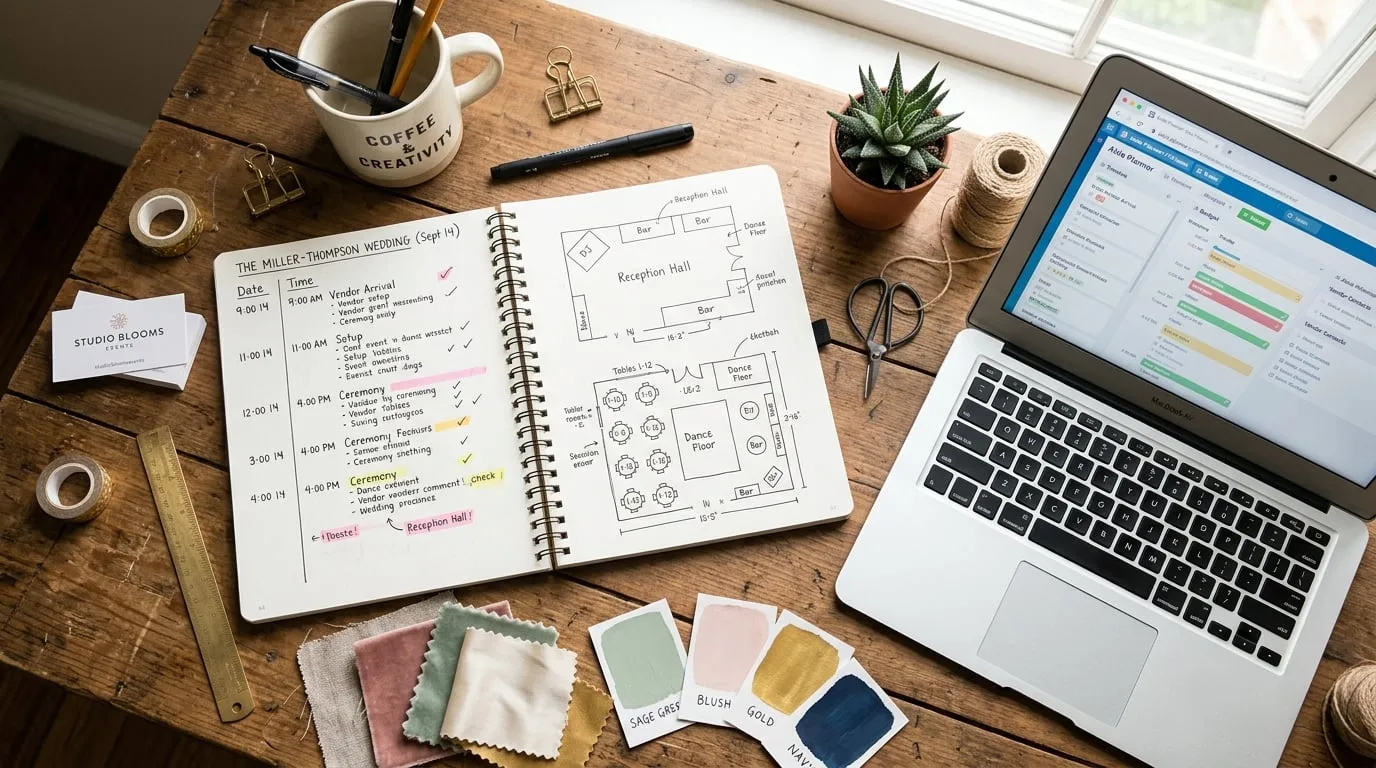
This is the heaviest stage. It produces the creative concept, the event identity and branding, the venue floor plan and layout, the run-of-show (minute-by-minute programme), the menu and beverage plan, the décor and styling brief, the entertainment and speaker programme, and the marketing and communications plan.
The run-of-show is the single most important document in this stage. It gives every supplier and team member a shared timeline, prevents dead time, and ensures transitions between programme elements are smooth. We typically go through 3–5 drafts before locking the final version.
Common mistake: under-investing in the run-of-show. A beautiful venue with clumsy transitions and awkward pauses still feels like a poorly-planned event.
Stage 4: Supplier Procurement
Book and contract every supplier: caterer (or confirm in-house), AV and staging, lighting, sound, entertainment (DJ, band, MC, speakers), photographer/videographer, florist and décor, furniture hire, staffing, transport, and security. For each supplier: get a written quote, confirm the scope of work, agree payment terms, and lock the cancellation policy.
A full-service event management company handles procurement and typically secures better rates through volume relationships. If you’re managing suppliers directly, book early — the best suppliers in Gauteng are fully booked by August for the October–December peak season.
Stage 5: Coordination and Logistics
This stage turns the plan into operational reality. Key logistics:
- Invitations sent, RSVPs tracked, dietary requirements and accessibility needs captured
- Seating plan built (if applicable)
- Transport and parking plans confirmed
- Signage and wayfinding designed and produced
- Permits and compliance documentation submitted (SASREA, liquor licensing, road closures, noise exemptions)
- Power and connectivity confirmed (especially for outdoor or off-grid venues)
- Weather contingency plan locked
- Final headcount given to venue and caterer 2–3 weeks out
Common mistake: leaving permits to the last minute. Municipal applications in Gauteng typically need 4–6 weeks. Late submissions mean rushed approvals or, worse, non-compliance.
Stage 6: Execution and On-site Management
On the day, the event management team runs the show. The client should be a guest, not the project manager. Key execution disciplines:
- Pre-event briefing: all suppliers briefed the day before or early on the day, with printed run-of-show and floor plan
- Single point of contact: the event manager is the only person issuing instructions to suppliers — not the client, not the client’s PA
- Real-time management: the event manager monitors the run-of-show, adjusts timing dynamically, and handles the inevitable surprises before the client notices them
- Contingency activation: the top 5 things that could go wrong (weather, power, no-show supplier, medical emergency, AV failure) each have a pre-agreed protocol
This stage is where experience matters most. An experienced event manager has seen every problem before and solves it before it reaches the client.
Stage 7: Post-event Review and Reporting
Within a week of the event, run a structured debrief with your team and your event management partner: what worked, what didn’t, what you’d change. Send a post-event survey to attendees. Measure your results against the KPIs from Stage 1. Compile a post-event report for the stakeholders who approved the budget — this is how you justify the next event and refine the approach for future ones.
The best organisations treat events as a continuous improvement cycle, not a series of standalone experiences. Each event’s debrief informs the next one’s brief.
How Long Does Each Stage Take?
- Stage 1 (Concept): 1–2 weeks
- Stage 2 (Feasibility): 1–2 weeks
- Stage 3 (Planning): 3–6 weeks
- Stage 4 (Procurement): 2–4 weeks (overlaps with Stage 3)
- Stage 5 (Coordination): 3–6 weeks
- Stage 6 (Execution): 1–3 days
- Stage 7 (Review): 1 week
Total: 10–16 weeks for a standard event; 16–24 weeks for a large conference or multi-day production.
Ready to Start?
B&W Productions manages all seven stages for corporate and social clients across South Africa. Get in touch to start with Stage 1, or use our event planning checklist to see where you are in the process.