Last updated: September 2026
The short answer
Start with the outcome you want, not the activity. Budget roughly R200–R800 per person for most standard formats and R1,000–R2,000 per person for facilitated strategy days, then plan 8–12 weeks ahead. Match the format to your group’s size, energy and goals and the day actually works.
If you are planning corporate team building in South Africa, start with the outcome you want, not the activity. The right event can improve connection, communication and morale. The wrong one just gives people another reason to fake a smile before lunch.
This guide is built for the research stage. It covers popular team building formats, realistic South African cost ranges, planning timelines and practical tips to help HR teams, office managers and leadership teams choose an event that actually fits their people.
Contents
- Why corporate team building still matters
- What team building looks like in South Africa
- Corporate team building costs
- How to choose the right event
- Common mistakes that ruin team building
- How far ahead should you book?
- From research to booking
- Frequently asked questions
Why Corporate Team Building Still Matters
Employee engagement remains a live business issue, not a fluffy HR side quest. Gallup reports global employee engagement at around 20% and estimates that low engagement costs the world economy about $10 trillion in lost productivity. Gallup’s long-running meta-analysis also links higher engagement with better productivity, profitability and customer loyalty, and lower staff turnover.
That does not mean every team building event works. It means well-designed team experiences still matter when they are tied to a real goal: better collaboration, stronger trust, smoother communication, a team reset after change, or simply giving people space to reconnect away from the inbox.
What Corporate Team Building Looks Like in South Africa
South African companies usually book team building in one of five buckets.
1. Outdoor team building
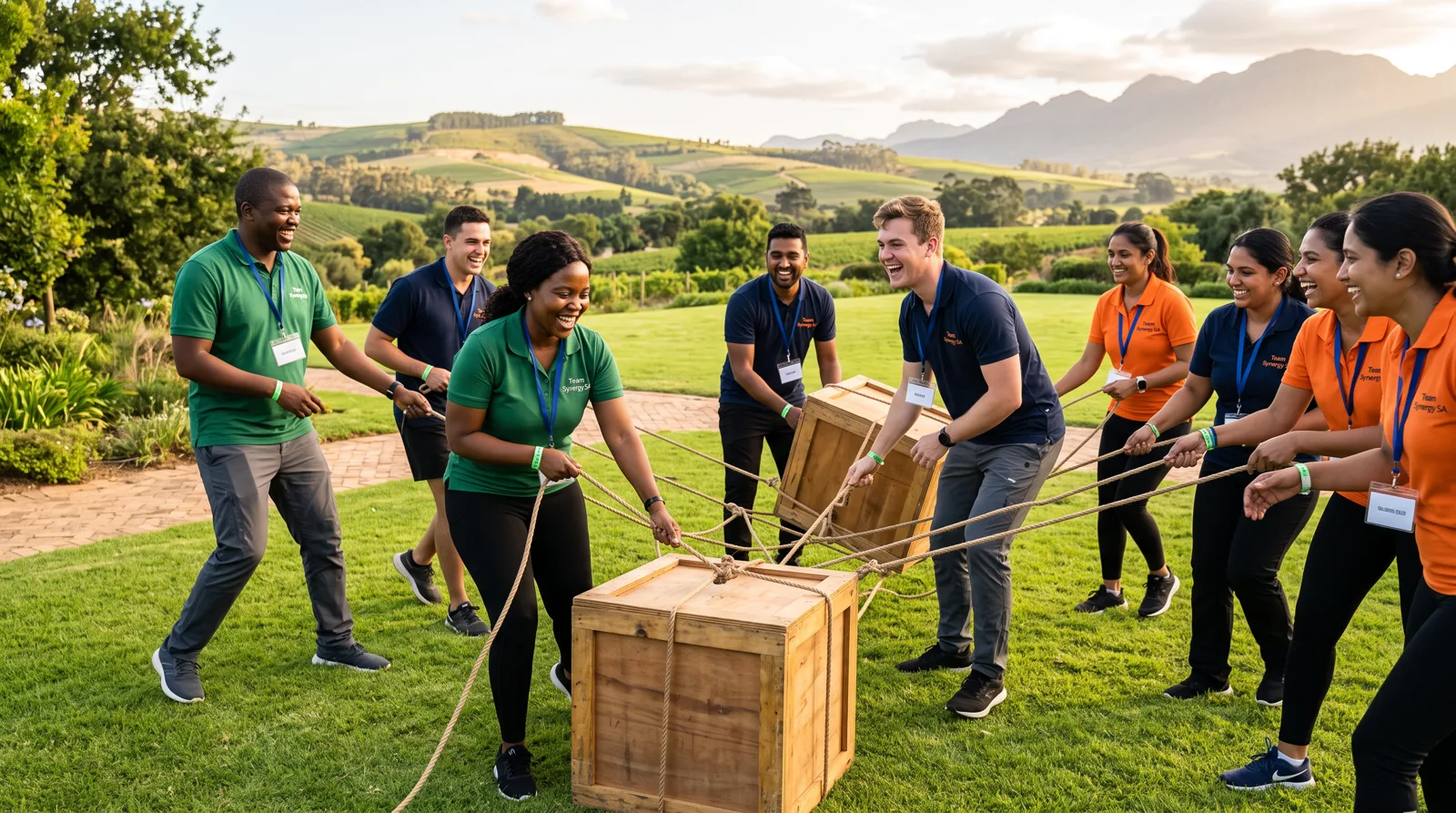
These are the high-energy options: Amazing Race formats, obstacle challenges, raft building, adventure races and venue-based field challenges. They work best for teams that want movement, momentum and a break from office routine.
2. Indoor team building
Indoor options are easier to control and easier to scale. Think escape challenges, quiz shows, game-show formats, creative problem-solving activities, drumming sessions and facilitated communication games. They are useful when weather risk is high or the group includes mixed fitness levels.
3. Creative and culinary experiences
Cooking challenges, potjiekos competitions, drumming, music-led sessions, art builds and collaborative workshops usually land well because they feel social without being painfully forced. In South Africa, local flavour matters. A generic imported activity can feel flat; a well-run local format usually does not.
4. CSR and community impact events
Many companies now want a team day that also creates visible social impact. Common formats include bicycle builds, food packing, school support projects, blanket drives and other beneficiary-led activities. These events can support corporate social investment goals, but the compliance treatment should always be confirmed with your own B-BBEE advisor and finance team.
5. Strategy-led or facilitated development days
These are less about games and more about outcomes. Workshops focused on leadership alignment, communication, conflict management or planning are often a better fit for executive teams than a standard fun day.
Corporate Team Building Costs in South Africa
Pricing in South Africa is messy because many providers do not publish clear rates. Based on published South African provider positioning, buyers should expect broad ranges rather than one neat market price. As a directional example, outdoor programmes are often positioned around R400–R800 per person, creative workshops around R300–R600 per person, CSI-style events around R200–R500 per person, and strategy-led programmes around R1,000–R2,000 per person.
Use those numbers as directional benchmarks, not universal rate cards. Final pricing changes based on group size, venue, travel, facilitation depth, equipment, catering, AV, branding and whether the event is packaged as part of a bigger corporate function.
A practical budgeting view
| Event type | Typical budget expectation | Notes |
|---|---|---|
| Budget-friendly indoor games | R200–R500 pp | Best for shorter sessions and easier logistics |
| Creative workshops | R300–R600 pp | Good fit for mixed personalities and fitness levels |
| Outdoor challenge formats | R400–R800 pp | Weather, transport and venue matter a lot |
| Facilitated leadership or strategy days | R1,000–R2,000 pp | More value sits in the facilitator than the props |
Exclude venue hire, catering, transport and VAT unless the quote clearly says they are included. For a wider view of corporate budgets, see our corporate event cost guide.
How to Choose the Right Team Building Event
Start with the goal
This is where most companies get it wrong. If the brief is vague, the event usually is too. Decide whether the main goal is:
- morale and reward
- better communication
- cross-team connection
- onboarding or integration
- leadership alignment
- CSR impact
- a year-end celebration with a team building element
When the goal is clear, the format gets easier to choose.
Match the format to the group
A 12-person leadership team and a 250-person mixed staff group do not need the same thing. Smaller groups can handle deeper discussion and workshop formats. Larger groups need flow, energy and smart rotation design.
Consider inclusivity early
Good team building should not quietly exclude half the room. Check mobility needs, language comfort, alcohol assumptions, dietary issues and physical intensity before you confirm the format. A team day only works when people can actually participate.
Plan around season and location
South Africa gives you strong outdoor options, but weather and travel still matter. Gauteng buyers often look for accessible venues with easy coach logistics. Cape Town opens more scenic options, but transport windows and cost creep need watching. If your team is spread across regions, a central venue or hybrid structure may make more sense.
Common Mistakes That Ruin Team Building Events
Booking the activity before defining the outcome
Looks obvious. Happens all the time.
Choosing energy over fit
A loud activity is not automatically a good activity. If the team is tired, tense, or mixed in age and personality, a softer format may perform better.
Underestimating logistics
Transport, parking, registration flow, dietary planning, timing and weather backup are not admin details. They are the event.
Forcing participation
Nobody loves being voluntold into awkward vulnerability exercises. Skilled facilitation beats pressure every time.
Treating the day as a standalone fix
One event can help. It will not magically repair broken leadership, poor communication systems or unresolved team conflict. If the problem is structural, say so and design accordingly.
How Far Ahead Should You Book?
A useful rule of thumb from South African market guidance:
- 8–12 weeks out: define goals, shortlist formats, set the budget and review venues.
- 6 weeks out: lock suppliers and confirm the venue.
- 4 weeks out: send attendee information and collect dietary or logistical requirements.
- 1 week out: confirm final numbers and operational details.
If the event is tied to year-end functions, peak dates or a large branded production, book earlier. South African event calendars get crowded fast in the final quarter.
From Research to Booking
Many people searching for corporate team building in South Africa are not ready to book on the first click. They want ideas, costs and a sense of what is possible. That is exactly the right way to start.
Once you understand the options, the cost drivers and the planning logic, the next step gets easier: a good partner helps you shape the right event around your team rather than selling you a format off the shelf. When you are ready to compare formats or price a specific group size, that is the moment to bring in help.
Frequently Asked Questions
What is the best corporate team building activity in South Africa?
There is no single best option. The best activity depends on your goal, budget, group size, venue and team dynamics. Outdoor challenges, indoor game formats, creative workshops and CSR events all work when they are matched properly to the people in the room.
How much does corporate team building cost in South Africa?
A practical starting range is about R200–R800 per person for many standard team building formats, while strategy-led or specialist facilitated sessions can run higher — roughly R1,000–R2,000 per person. Venue, catering, travel and production costs usually sit outside the base activity price, so confirm what a quote includes.
How do I choose team building activities for work?
Start with the outcome you want — morale, communication, connection, onboarding or leadership alignment — then filter by group size, physical intensity, location, season and budget. If you do it the other way around and pick the activity first, you usually end up with the wrong fit.
Are indoor team building activities better than outdoor ones?
Neither is better — they are just different. Indoor formats are easier to manage and more weather-proof, and they scale well for mixed fitness levels. Outdoor formats usually create stronger energy and movement. The right choice depends on your group, the season and the goal.
How far in advance should we plan a team building event?
For most standard events, start planning at least 8–12 weeks ahead: define goals, shortlist formats and set a budget early, lock suppliers around six weeks out, and confirm final numbers in the last week. Large events, year-end functions or custom builds need more runway — South African diaries fill fast in the final quarter.
Key takeaways
- Start with the outcome you want, then choose the format — never the other way around.
- Budget roughly R200–R800 per person for standard formats; R1,000–R2,000 for facilitated strategy days.
- Venue, catering, transport and VAT usually sit outside the base activity price.
- Match the format to group size, energy, inclusivity, season and location.
- Plan 8–12 weeks ahead — more for year-end or custom-built events.
The Bottom Line
Corporate team building in South Africa works best when it is built around the team, not the trend. The event should match the group’s size, energy, goals and logistics. Get that right, and the day feels useful. Get it wrong, and it becomes a long lunch with name tags.
B&W Productions has delivered more than 10,000 events across South Africa since 1993. If you want help shaping a team day that fits your people, explore our corporate events and experiential events, or request a quote for your group size.