TL;DR
An event production company owns the staging, sound, lighting and trucks — and supplies the technical crew to build your event. An event planner coordinates logistics and sub-hires that equipment from third parties. For anything beyond a small, fully-serviced-venue function, a production company (or an integrated turnkey operator) delivers lower total cost and single-point accountability.
Key Takeaways
- Production = infrastructure. Staging, sound, lighting, power, rigging, vehicles, crew.
- Planning = coordination. Timelines, guest lists, vendor management, aesthetic direction.
- Turnkey = both. One contract, one team, one accountability line — and no sub-hire markup chain.
- Compare total landed cost, not just the management fee.
- Check insurance, SASREA compliance and B-BBEE status before you sign.
What each role actually does
The South African events industry uses “event planner” and “event production company” almost interchangeably — and the confusion costs clients money. The two roles overlap, but they are not the same thing.
Event planner
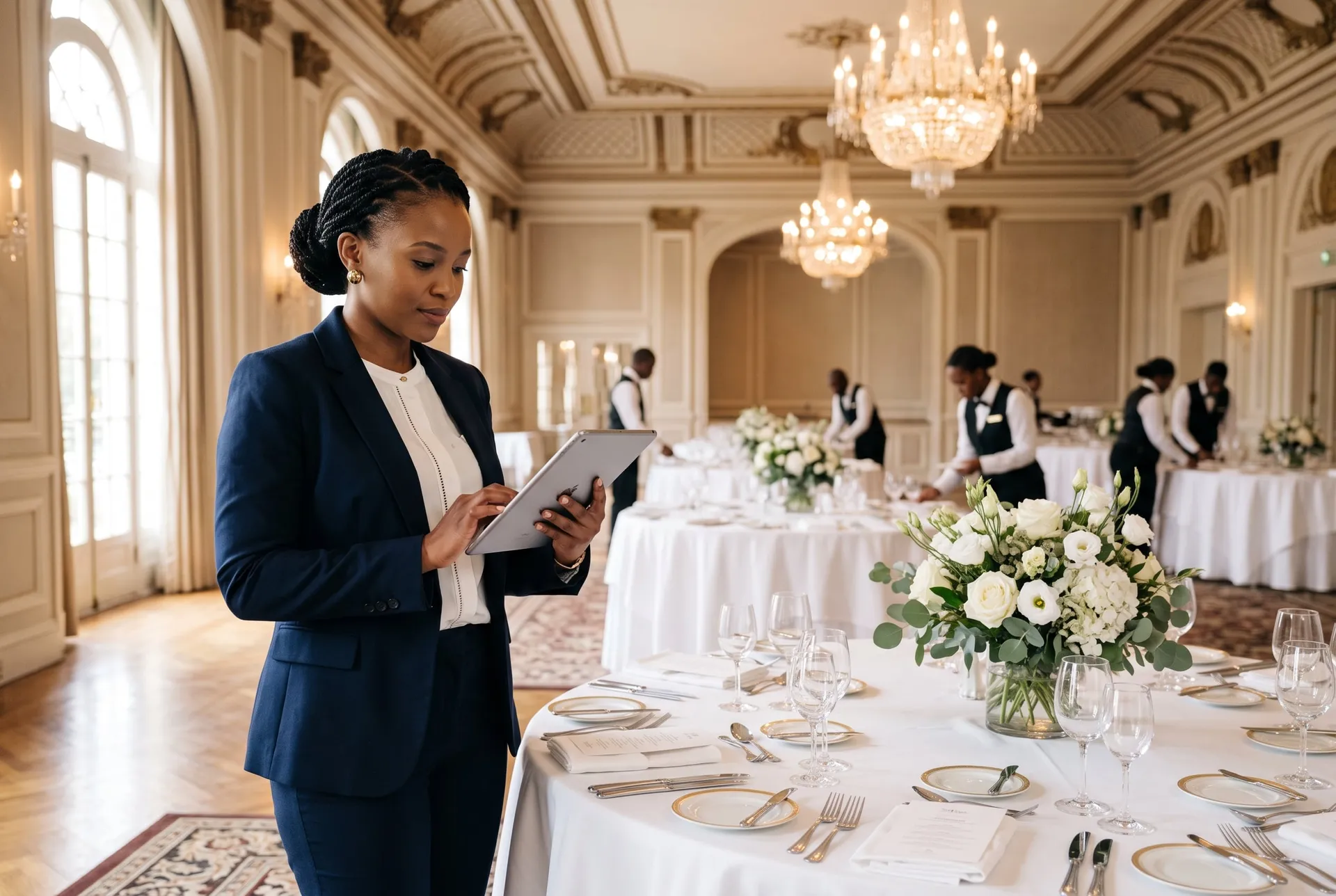
An event planner is a coordinator. They manage the timeline, the guest list, the vendor roster, the seating plan, the aesthetic direction and the run sheet. Their tools are spreadsheets, mood boards and supplier relationships. When your event needs staging, lighting or sound, they source it from third-party hire companies — each of which adds its own margin.
This model works well for events held at fully serviced venues where the infrastructure is built in: a boutique wedding, a boardroom dinner, a private party for under 100 guests.
Event production company
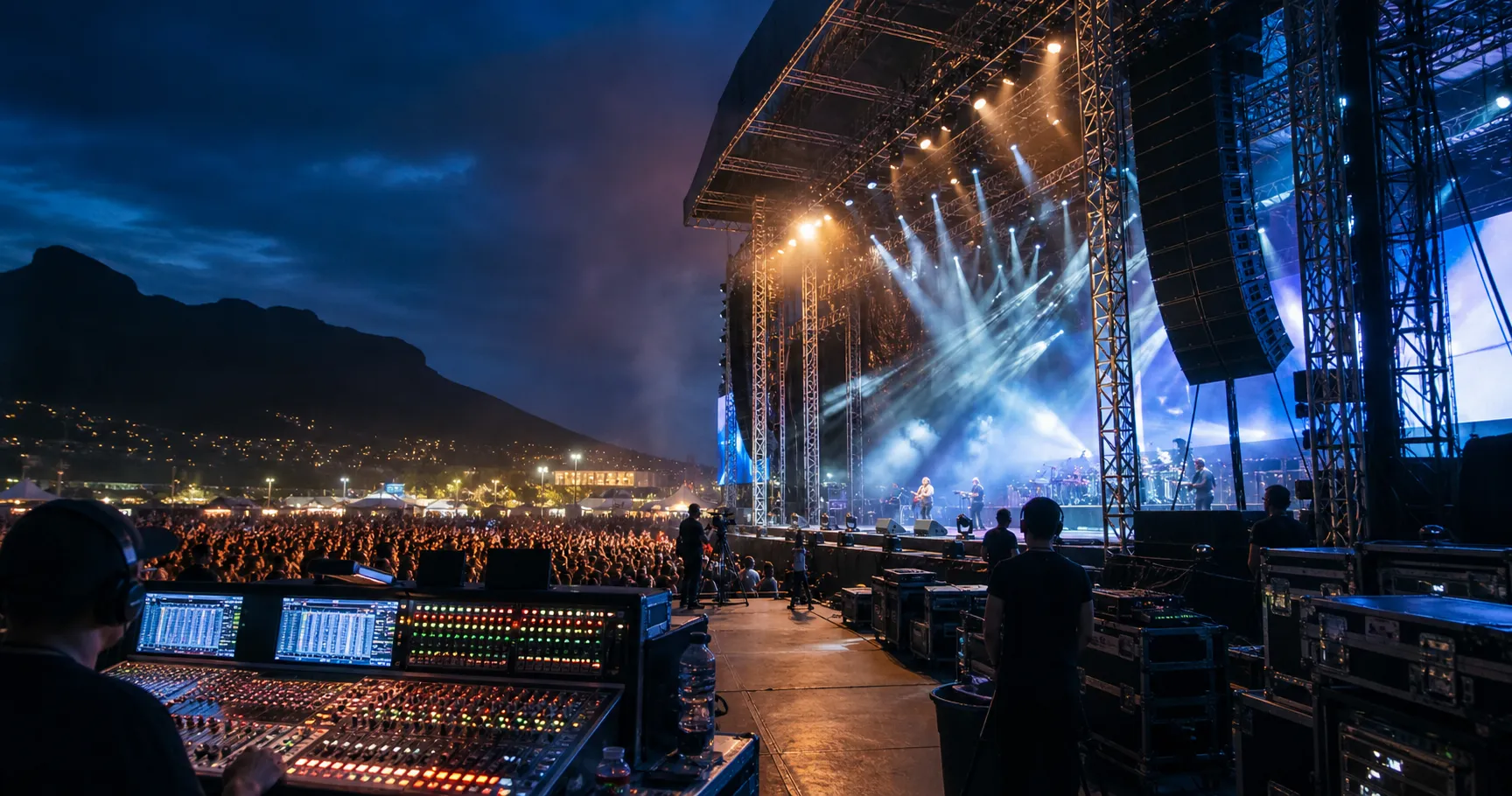
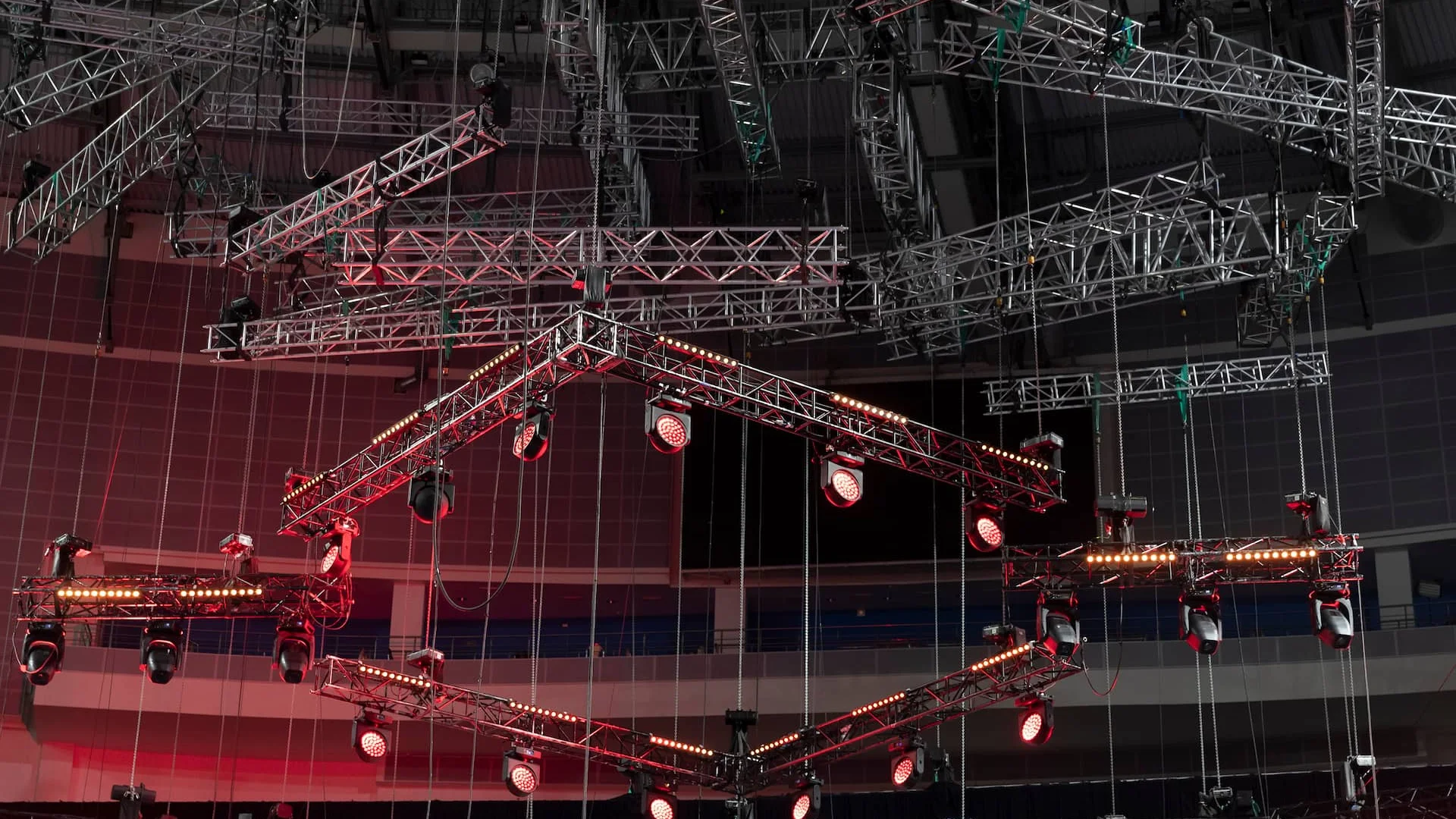
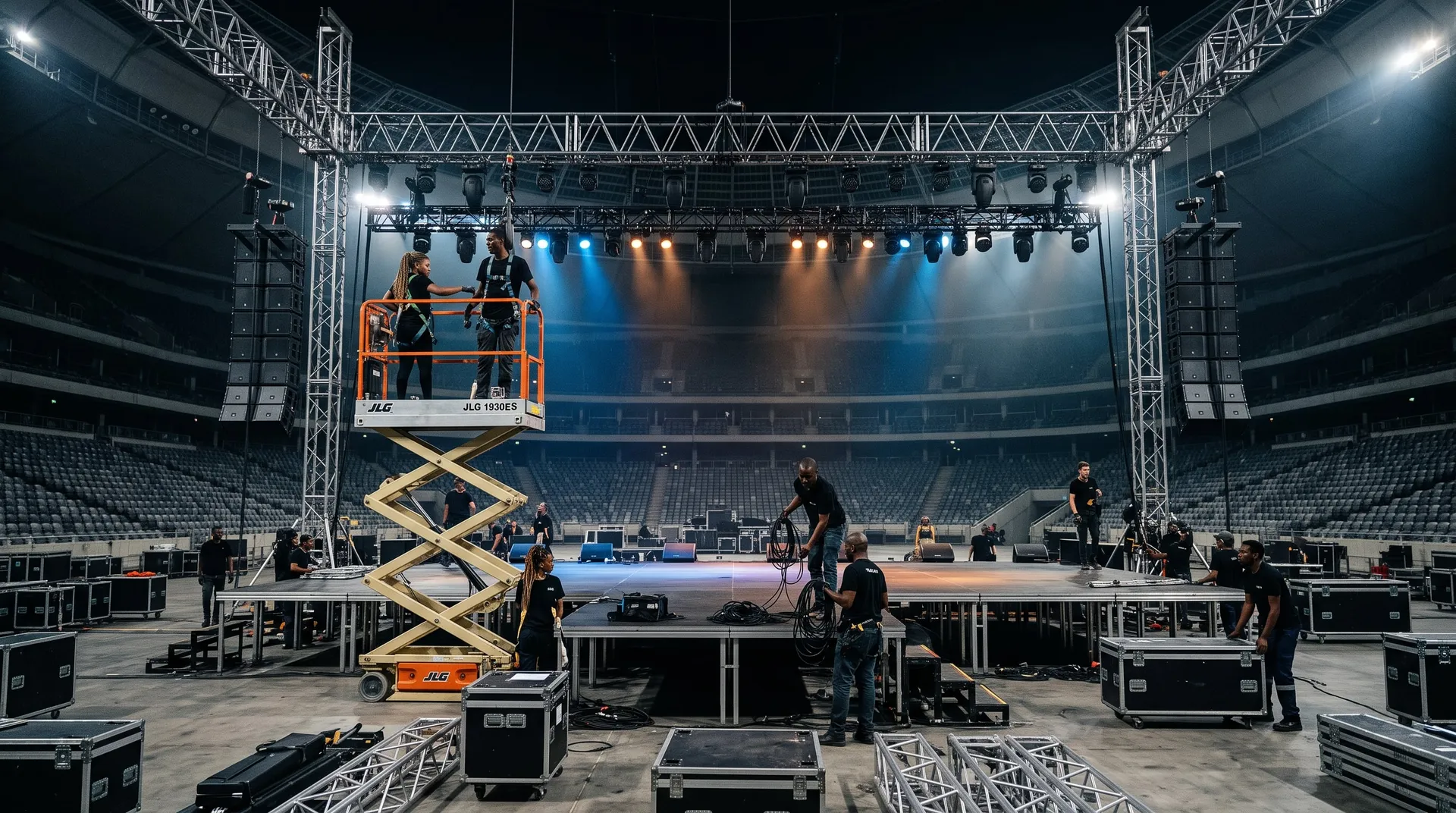
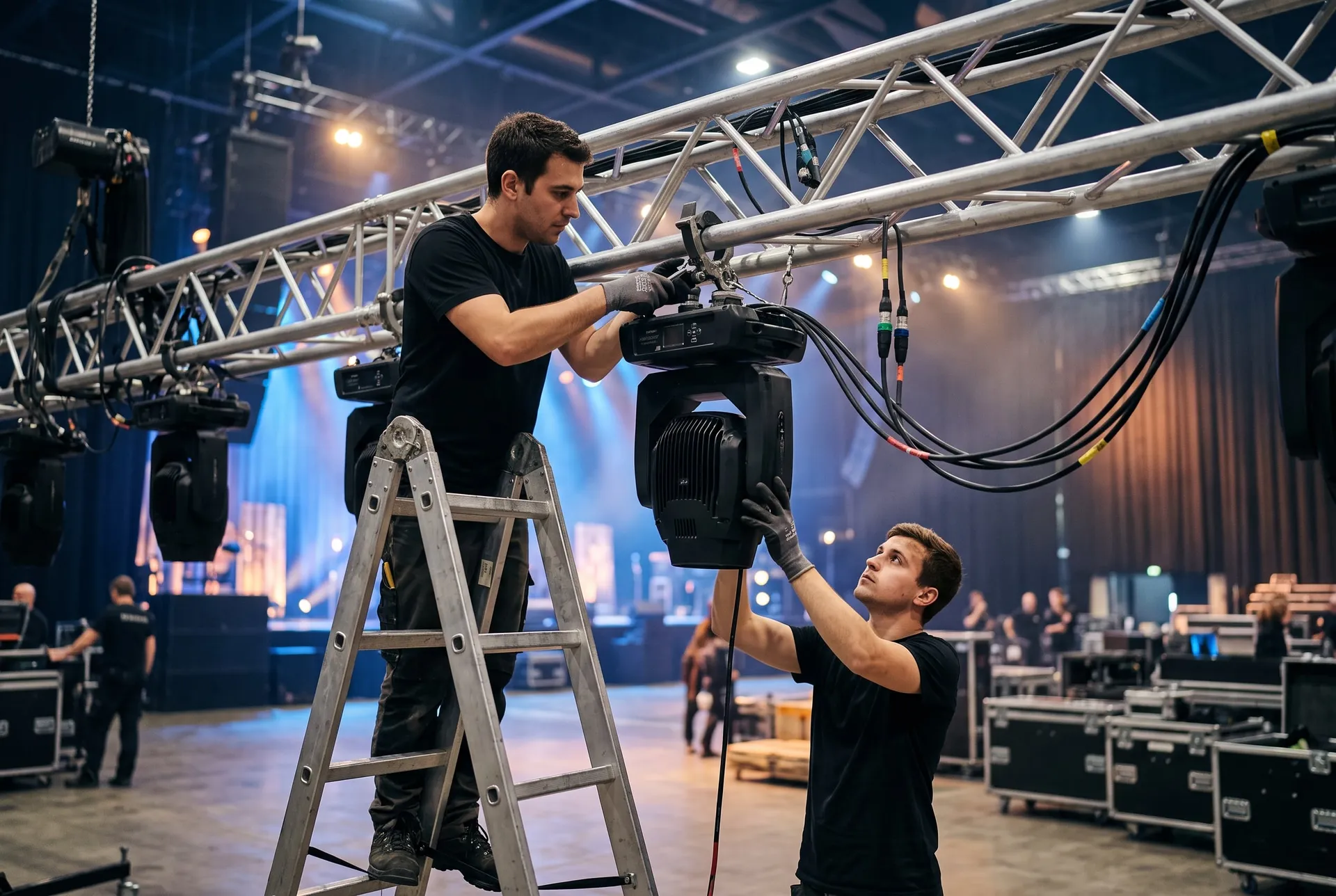
An event production company owns the physical infrastructure — staging decks, truss and rigging systems, sound consoles, lighting rigs, LED walls, generators, vehicles — and employs the technical crew to design, build and operate it. When you hire a production company, the equipment and the expertise arrive on the same truck.
At B&W Productions, for example, that means a 2,000 m² warehouse, 10+ owned trucks, and in-house staging, lighting, sound, AV and special effects — no third-party sub-hire markups. The same team that quotes the job is the team that builds and runs it.
Turnkey (integrated) model
A turnkey event company combines both functions under one contract: creative planning and physical production. One point of contact, one invoice, one team accountable from concept through load-out. This model eliminates the coordination risk and markup chains that arise when a planner manages a separate production supplier, who in turn manages sub-contractors.
Side-by-side comparison
The table below maps the key dimensions a corporate buyer or brand manager should evaluate when choosing between a standalone event planner and a production company.
| Dimension | Event Production Company | Event Planner |
|---|---|---|
| Core function | Design, build and run the technical event | Coordinate logistics, vendors and timelines |
| Owns equipment | Yes — staging, sound, lighting, AV, vehicles | No — sub-hires from third parties |
| In-house crew | Yes — technical, rigging, AV operators | No — outsources crew per event |
| Typical fee | 8–15% of project budget (equipment at internal rates) | 10–18% of event budget (equipment billed separately) |
| Total landed cost | Often lower — no sub-hire markups | Can be higher — each supplier adds margin |
| Single accountability | Yes — one team, concept to load-out | Shared — planner + production vendor + subs |
| Risk management | Direct control over safety, power, rigging | Relies on suppliers’ compliance |
| Insurance | Public liability, equipment all-risk, employer’s liability | Professional indemnity; equipment covered by hire co. |
| SASREA compliance | In-house expertise for large-capacity events | Typically sub-hires safety officer |
| Best for | Conferences, concerts, brand activations, festivals, product launches | Small private events, boutique weddings, serviced-venue functions |
Cost comparison — total landed cost
Comparing management fees in isolation is misleading. A planner’s 12% fee looks cheaper than a production company’s 10% fee — until you add the third-party production invoices the planner is managing, each carrying its own 15–30% margin.
The only honest comparison is total landed cost: everything your organisation pays, from every supplier, to deliver the finished event.
| Line item | Via production company | Via planner + sub-hire |
|---|---|---|
| Venue hire | R65,000 | R65,000 |
| Catering (200 × R450) | R90,000 | R90,000 |
| Staging, AV & lighting | R85,000 (owned) | R110,000 (sub-hired + margin) |
| Décor & theming | R35,000 | R42,000 |
| Entertainment & MC | R30,000 | R30,000 |
| Technical crew (in-house) | R25,000 | R38,000 (freelance) |
| Management fee | R43,000 (10%) | R52,500 (12%) |
| Contingency (10%) | R37,300 | R42,750 |
| Total landed cost | R410,300 | R470,250 |
In this worked example, the production-company route saves roughly R60,000 (≈ 13%) — primarily because staging, AV, lighting, décor and crew are supplied at internal rates with no sub-hire markup. The gap widens on technically complex events (concerts, brand activations, outdoor builds) where equipment and crew form a larger share of the budget.
Note: these are illustrative figures based on 2026 market rates in Gauteng. Your actual quote will vary by venue, specification and season.
Decision tree — which do you need?
Work through these questions in order. The first “yes” tells you which model fits.
- Does the event need custom staging, outdoor power, large-scale sound or lighting design?
Yes → Event production company (or turnkey). - Will it be held at a fully serviced venue with in-house AV and catering?
Yes → An event planner can manage it. But if the production spec is ambitious, a production company still adds value. - Is guest count above 500, or does the event fall under SASREA?
Yes → You need a partner with SASREA compliance experience and public liability insurance — that is almost always a production company. - Do you need one team accountable from concept to load-out with no finger-pointing between suppliers?
Yes → Turnkey production company. - Is the event a small private function (under 80 guests) at a venue that provides everything?
Yes → A good event planner is the right (and most cost-effective) choice.
Most corporate events, brand activations, product launches and conferences land on questions 1 or 3 — which is why production companies dominate the corporate and FMCG event space in South Africa.
Compliance, insurance and B-BBEE
Three compliance dimensions matter when choosing an event partner in South Africa:
SASREA (Act 2 of 2010)
The Safety at Sports and Recreational Events Act applies to events above certain capacity thresholds. A production company with SASREA experience handles the safety plan, emergency protocols, crowd management and documentation as part of the production scope. If your planner does not carry this expertise in-house, they will need to appoint (and mark up) a third-party safety officer.
Insurance
Ask for proof of: public liability (R10m+ for large-scale events), equipment all-risk, employer’s liability for crew, and motor insurance if the company operates its own fleet. An event planner should carry professional indemnity insurance — but the production equipment is covered by whoever owns it, not by the planner.
B-BBEE
Corporate procurement in South Africa often requires a minimum B-BBEE level. A company that is B-BBEE Exempt (qualifying micro-enterprise) or holds a verified level certificate simplifies your compliance. Ask for the certificate or affidavit — and check the expiry date. B&W Productions is B-BBEE Exempt, with an affidavit available on request.
POPIA (Act 4 of 2013)
Any event partner handling guest lists, RSVP data, delegate registration or payment details must comply with POPIA. Ask how personal data is stored, what the retention period is, and whether a data processing agreement is in place. A responsible operator will offer this unprompted. For more on POPIA in the events context, see our privacy policy.
Red flags to watch for
Whether you are vetting an event planner or a production company, these warning signs should give you pause:
- No itemised quote. A single lump-sum figure with no line-item detail hides markups. Demand transparency.
- No proof of insurance. If they cannot produce a current certificate of insurance, walk away.
- The quoting team is not the execution team. You want the people who plan the event to be the people who run it on the day.
- “We sub-hire everything.” If a company calling itself a “production company” owns no equipment, you are paying production-company fees for planner-level service.
- No SASREA awareness. If your event is above 2,000 capacity and the company has never heard of SASREA, they are not equipped for the job.
- Vague on B-BBEE. “We’re busy getting it” is not a certificate. Ask for the document.
- No site visit before quoting. A credible production company will inspect the venue, check power supply, measure load-in access and assess rigging points before finalising a quote.
- Payment in full upfront. Industry standard is a 50% deposit with the balance due pre-event or on completion. Full upfront payment removes your leverage if things go wrong.
10 questions to ask before you sign
Print this list. Take it into the meeting. A credible partner will answer every question without hesitation.
- Do you own your production equipment, or do you sub-hire?
- What is your public liability insurance cover — and can I see the certificate?
- How is your fee structured — percentage of budget, flat rate, or day rate?
- Will the team that quotes be the same team on site?
- Can I see a fully itemised quote with every line item broken out?
- Do you have SASREA compliance experience?
- What is your B-BBEE status — and when does the certificate expire?
- How do you handle POPIA — data processing agreement, retention period, guest-data security?
- What is your cancellation policy, and at what point are deposits non-refundable?
- Can you share three references from events of a similar size and type?
If a company struggles with any of these, that tells you something. The right partner will welcome the scrutiny.
For a broader look at how to evaluate event management companies in Gauteng, read our buyer’s guide to event management companies in Gauteng.
Frequently asked questions
What is the difference between an event production company and an event planner?
An event production company owns physical infrastructure — staging, lighting rigs, sound systems, trucks, generators — and provides the technical crew to build and run the event. An event planner coordinates logistics such as venue selection, guest lists, timelines and vendor management but typically sub-hires all production equipment from third parties. A production company delivers the event; a planner organises it.
Can one company do both production and planning?
Yes. Integrated or turnkey companies handle both the creative planning and the physical production under one roof. This eliminates finger-pointing between suppliers, reduces markup layers and keeps one team accountable from concept to load-out. B&W Productions operates this model — concept, plan, design, build and execute with owned equipment and in-house crew.
Is an event production company more expensive than an event planner?
Not necessarily. A production company's fee includes the equipment and crew at in-house rates, so there is no sub-hire markup. A planner's fee looks lower on paper, but the overall project cost can be higher once you add the third-party production invoices — each carrying its own margin. Compare total landed cost, not just the management fee.
When should I hire an event planner instead of a production company?
An event planner is the right fit when your event is primarily a coordination exercise — a boardroom dinner for 30, a small private party, or a corporate function at a fully serviced venue where production infrastructure (staging, lighting, AV) is built into the venue package. If you need custom staging, outdoor power, large-scale sound or lighting design, a production company is the better choice.
Do event production companies handle catering and décor?
Many production companies include catering, décor and theming as part of a turnkey package. Others focus on technical production and partner with specialist caterers or décor suppliers. Ask upfront whether the company operates a full-service model or a production-only model so you know who manages each line item.
What insurance should an event production company carry?
At minimum: public liability insurance (R10m+ cover is standard for large-scale work), equipment all-risk insurance, employer's liability for crew, and motor insurance for the fleet. For events above 2,000 capacity, SASREA (Act 2 of 2010) may require additional safety compliance documentation.
What does SASREA mean for choosing a production partner?
SASREA — the Safety at Sports and Recreational Events Act (Act 2 of 2010) — applies to events above certain capacity thresholds in South Africa. A production company with SASREA experience will handle the safety plan, emergency protocols and compliance documentation. If your planner does not carry this expertise, they will need to sub-hire a safety officer, adding another cost layer.
What questions should I ask before signing with an event company?
Key questions: Do you own your production equipment or sub-hire? What is your public liability cover? How is your fee structured — percentage or flat rate? Who is the on-site project lead? Can I see a fully itemised quote? Do you handle SASREA compliance? Are you B-BBEE rated? Will the same team that quotes be the team that executes?
How much does an event planner charge in South Africa?
Event planners in South Africa typically charge 10–18% of the total event budget, or a flat planning fee starting from about R5,000 for a small event up to R30,000+ for a large corporate function. This fee covers coordination, vendor management and timeline oversight — not the production equipment or crew, which are billed separately by suppliers.
How much does an event production company charge in South Africa?
An event production company's management fee is typically 8–15% of the project budget, but because their quote includes owned equipment and in-house crew at internal rates, the total landed cost is often lower than a planner plus third-party suppliers. For a medium corporate event, total production costs typically run R150,000–R600,000 depending on scale and technical requirements.
What is a turnkey event production company?
A turnkey event production company delivers the entire event under one contract — from concept and creative planning through technical design, build, execution and post-event breakdown. The client gets one point of contact, one invoice, and one team responsible for everything. This model reduces coordination risk and eliminates the markup chains that arise when multiple independent suppliers are involved.
Does B-BBEE status matter when choosing an event company?
For corporate clients in South Africa, yes. Procurement policies often require a minimum B-BBEE level. A company that is B-BBEE Exempt (qualifying micro-enterprise) or holds a verified level certificate simplifies your compliance. Ask for the B-BBEE certificate or affidavit before signing — and check the expiry date.
Not sure which model fits your event?
Tell us the brief. We’ll tell you honestly whether you need a full production team — or whether a simpler planning-only approach will do the job. No obligation, no jargon.